Whatever happened in the year 4 Reed?

Abstract: An interpretation is proposed for some glyphs depicting an obscure historical event in Tizoc’s reign, which can be found in Codex en Cruz 7, Codex Azcatitlan 19v. They refer to an Otomi rebellion at Chapa de Mota, consignated in Anales de Tlatelolco and Codex Huichapan f52

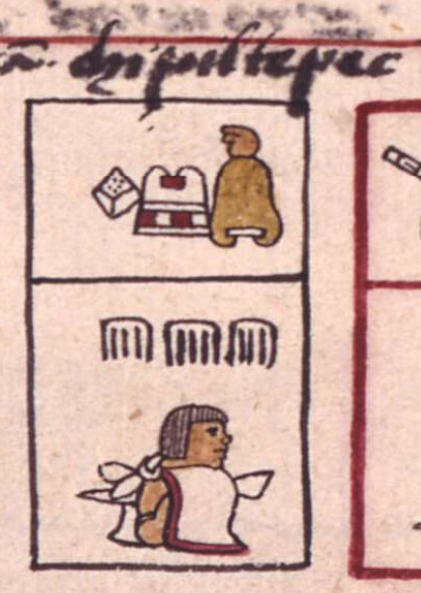
Since our knowledge of Aztec pictorials is relatively extensive, thanks in no small part to colonial glosses and the continued attention of modern scholars since the work of Aubin, not many people talk nowadays about any “mysteries” in Aztec writing, in contrast to the still important number of undeciphered signs in Maya writing, or the uncertainties surrounding Mixtec pictorials. However, the truth is that some “passages” in Aztec codices are indeed rather elusive. This entry is about one such obscure sections in a document that deserves more contemporary attention: I am referring to the Codex en Cruz, excellently edited and studied by Charles E. Dibble (1981). However, despite Dibble’s authoritative, accurate and (almost) exhaustive comment, there are still some parts of this document which are in the dark for our current knowledge. One of them is the upper section of the year 4 Reed (1483) in folio 7 in Dibble’s copy, G in the diagram that accompanies the original at the Bibliothèque Nationale in Paris. This small bit of history, which happened during the reign of Tizoc, is only denoted by three mysterious signs: that of a snake above a disk of water, a wooden beam (huepantli), and a shield with a macuahuitl, which in this document usually denotes war (Figure 1).

Figure 1. a) The year 4 Reed (Codex en Cruz 7); b) The ‘water-snake’ and the ‘shield, macuahuitl and beam’ event in question, in the upper section. Both drawings are from Charles Dibble.

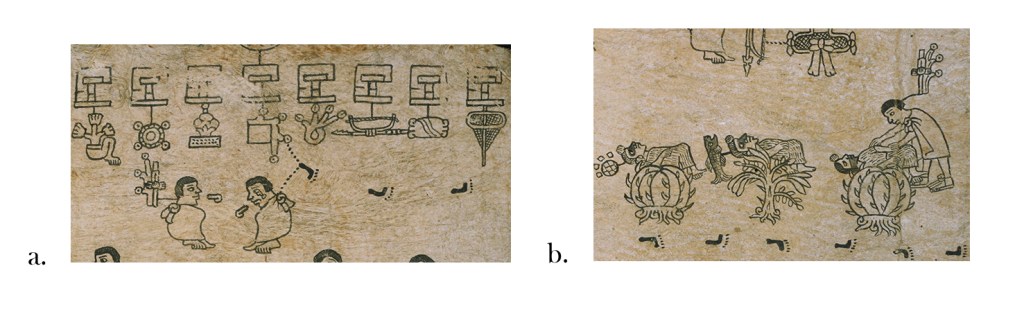
Before venturing a new reading of this passage, it is necessary to explain its context, and what Dibble has already said about it. The year 4 Reed or 1483 in the second 52 year cycle depicted in the Codex en Cruz corresponds to the reign of Ahuizotl, the short-lived seventh tlatoani of Tenochtitlan. Despite being a Tetzcocan manuscript, the history of Tenochtitlan, the seat of the power of the Culhua-Mexitin, is constantly present in it. The first sequence above the year sign has been interpreted by Dibble as the birth of a character named Huaxtzin in Chiauhtla; the second, to the raising of a temple at a location that may be very well Chiauhtla itself too (1981: 27). After this, another line divides the geographical scope of the events depicted in the column, and the glyph of Tenochtitlan situates the rest of the signs in relationship to this polity. Dibble (1981: 28)correctly interprets the event depicted directly above the Tenochtitlan sign as the laying of the foundation of the temple of Huitzilopochtli, one of the main events in Tizoc’s reign: we can see the king with his name-glyph, working with a digging stick above the foundation , an event depicted in most extant pictorial chronicles about his reign (like the Telleriano-Remensis and the Azcatitlan).

Afterwards, two captives are seen above the king, each associated to different glyphs. Dibble correctly observed that they were from Huexotzinco, thanks to the curved lip ornament that denotes the inhabitants of this Altepetl. He hypothesized that they were name-glyphs, but they are difficult to read: the first is interpreted by him to be an eagle, but the problem is that such predator could denote many names: Cuauhtzin and Tlotli are a couple of alternatives, among many others; the second, mostly effaced in the original, is even more obscure. A probable clue lies in Chimalpahin, which relates that in the year 4 Reed, not only the foundations of the temple of Huitzilopochtli were laid, but also captives from Cozcacuauhtenanco and Tlaollan were sacrificed (1998: 275). The first glyph could certainly resemble collar-less versions of the glyph COZCACUAUH, which are rare but do exist, or perhaps is a mere abbreviation of CUAUH. The second glyph, however, is almost impossible to figure out: it seems to be a face with a bun on its back, and therefore seems to have no relationship to the well-known toponym for Tlaollan, a basket with corn kernels, so this issue must be left unsolved for now, although I suspect that another close examination of the original could reveal something, since the different copies by León y Gama, Pichardo, and Dibble all disagree.

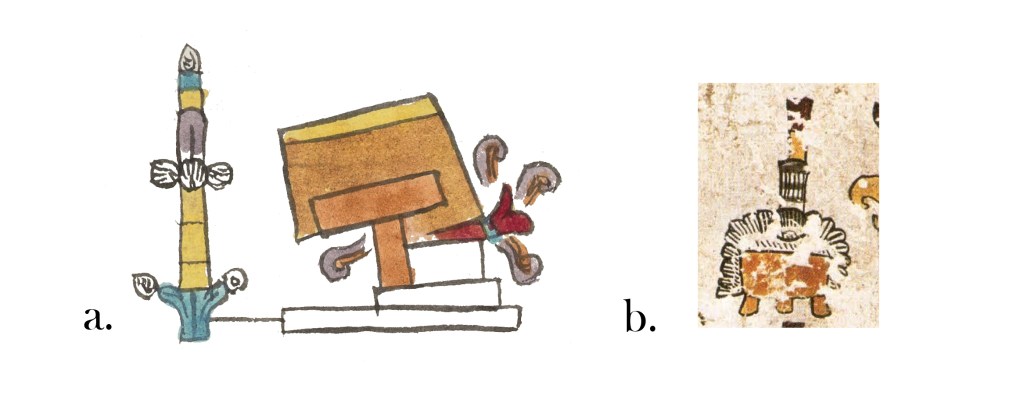
The names, or perhaps places of origin, of these captives are certainly an interesting question, but the mystery regarding what follows is the focus of this entry. Dibble, with a very insightful intuition, observed that an unknown toponym composed of a serpent with water, the shield and macuahuitl sign, and a beam (huepantli) sign, suggested a war-event related to the procurement of beams for the construction of Huitzilopochtli’s temple. He also relates these signs with a parallel and also obscure event depicted at Codex Azcatitlan 19v, which also happened during the reign of Tizoc: after the foundation-laying event in Tenochtitlan, denoted by a wall, a huictli (compare with Telleriano Remensis 38v), and the name-glyph of that polity, a very obscure compound of signs follows: the wooden beam sign with a cord, a shield, a deer’s head, and the name of an unknown place denoted by a body of water and a flag. Both passages remain obscure until now: Barlow suggested the reading Ahuepanco for the place by joining the water and beam signs. Recent re-examinations of the Azcatitlan, such as those by Graulich (1995: 120) and Rajagopalan (2019: 64), offer again Barlow’s tentative reading while remaining a bit skeptical.
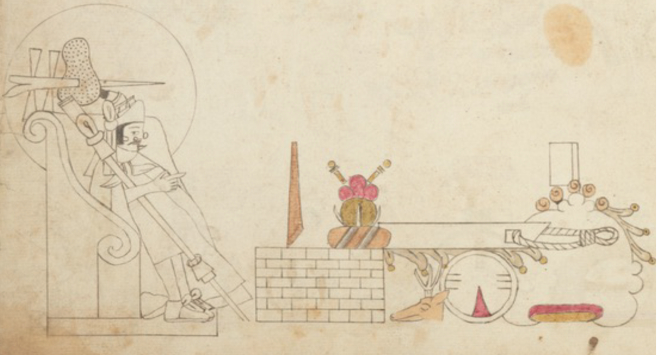
Figure 2. The reign of Tizoc, Codex Azcatitlan 19v.

Before offering a new interpretation/reading for this passage, something must be said about the main aspect of Aztec writing that is still obscure or undecided for us: what is the real nature of the signs that are neither toponyms nor calendric signs, nor numbers, nor names, which sometimes become completely difficult to differentiate from “writing proper” due to the iconic nature of the Aztec script, but definitely carry more information than their logosyllabic counterparts? For example, in this passage: what are the “shield and macuahuitl” sign which seem to denote the action of war rather than just the word yaotl, and the beam sign, which seems to denote more than the mere word huepantli, codifying a little story of sorts? Many labels have been offered for such signs: semasiography (Galarza 1990, Boone 2000), iconography (Lacadena 2008) or, a proposal that has great potential, that of “embedded texts” of Janet Berlo (1983), which Albert Davletshin (2003: 62) and Dmitri Beliaev (2016: 205) have urged us to re-consider. However, it is more prudent to “suspend judgment” on this question for now, but it is important to keep it in mind, because it can give us an inkling on what Aztec writing itself was about.

The truth is that the method of interpretation followed by Dibble was very insightful and pertinent, and, as we will see, it retains its relevance. Roughly speaking, it consisted in assessing the glyph’s iconography and consider possible readings, and then offering an explanation for their apparition through parallel events in alphabetic chronicles and other pictorials in order to substantiate the interpretation. After searching for possible parallels, I feel that it is possible to propose a reading for this passage, which was obtained by following a similar method to that of Dibble, although aided by the enormous advances in the catalogation and understanding of Aztec script brought by later specialists (Thouvenot 2012; Zender et. al. 2013).  As mentioned, the idea was simple: to look for passages of historical events associated to Tizoc which can be related to these glyphs regarding of what they looked like, and see if anything could fit. The relevant passage is in a source that Dibble actually used in his edition of the Codex en Cruz: Anales de Tlatelolco. There we read the following concerning the year 5 Flint (1484):

Quiualtzaque in chiapantlaca, uepanato Itzmiquilpa, ahuehuetl in quiuillanato ytlaquetzallo yezquia yteucal Huitzilopochtli; y no umotlatziuhcaneque contlatique yn iuepamecauh y quiualtzaque.

The Chiapantlaca rebelled, they were cutting ahuehuetes in Iztmiquilpan, which they dragged to make the columns of the temple of Huitzilopochtli: they rebelled when they worked with laziness and burned the cords which they used to drag the logs (Tena 2004: 96-97).

Thus, we have a passage clearly related to the context that Dibble (correctly) guessed: a rebellion or war event related to the beams used to start building the temple of Huitzilopochtli, which happened during the reign of Tizoc. The only difference is the date, which in the Tlatelolco chronicles is set one year later, but the rest of it is identical: furthermore, the Tlatelolco document set the accession date of Tizoc 1 year later than the Codex en Cruz, at 3 Rabbit, but the discrepancy is easily explained through the disparity of local historiographic traditions. But what about the glyphs? The ‘snake and water’ sign is clearly the toponym of Chiapan/Chiyauhpan. It is related to the root chiyauh, ‘filth, grease’; Molina also reports that chiyahuitl was a certain kind of snake (Wimmer 2004a), probably living in swamps. It seems that this root was either depicted by a marsh, by the snake, or by both, to form the logogram CHIYAUH, ‘filth, grease, swamp snake’. The CHIYAUH logogram appears in the Matricula de Huexotzinco to denote the name chiyauhcoatl, or ‘marsh snake’, and the toponym chiyauhtzinco, “place of the little marsh”, for Chiyauhtlalli means swamp or marsh, just as the name sign depicts.[1] Thus, the snake and water sign is a somewhat abbreviated form of the toponym Chiyauhpan, or Chiapan, “place of marshes”. This can be better understood by comparing with the renditon in the Azcatitlan, which has the marsh sign next to a flag or pa syllabogram, forming CHIYAUH-pa, Chiyauhpan.
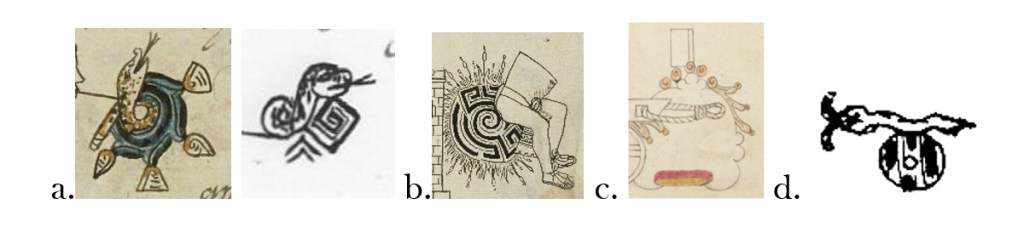
Figure 3. a) CHIYAUH-COA, Chiyauhcoa(tl) (Matrícula de Huexotzinco 711r, 816r); b) CHIYAUH-tzin, Chiyauhtzin(co) (Matrícula de Huexotzinco 601r; cfr. Thouvenot 2012); c) CHIYAUH-pa, Chiyauhpan, Chiyauhpan (Azcatitlan 19v); d) CHIYAUH, Chiyauh(pan), Chiyauhpan. (Codex en Cruz 7).

The rest is, of course, easy to understand in the Codex en Cruz through the parallel alphabetic passage in the Anales de Tlatelolco, but not so in the Azcatitlan. In the Codex en Cruz, the ‘shield and macuahuitl’ sign is a ‘pictogram’ for war/rebellion, as it is in the rest of the Codex, while the beam or huepantli sign explains the circumstances of this war: hence, the final reading would have been similar to that offered in the Anales de Tlatelolco. But what about the Azcatitlan? Here something interesting happens. The toponym Chiyauhpan is clearly read CHIYAUH-pa: the tepetl or ‘mountain’ sign is, again, ‘iconographic’, ‘semasiographic’ or whatever terminology we want to use, only denoting the abstract idea of an Altepetl polity, the place where the action occurred. But what about the water sign, which gives an unlikely complement to huepantli? It is probable that this sign simply is a spelling added to indicate something like ahuehuepantli, that is, ‘beams made of the ahuehuetl tree’. Another explanation, offered to me by Gabriel Kruell, is that the sign actually denotes the verb huepana, “to drag wood”, a solution that is also likely. The shield sign is another variant for the aforementioned pictograph of war, and is identical to the version present at the Codex Aubin; however, its motivation is also related to how the war actually started, according to Otomí sources.

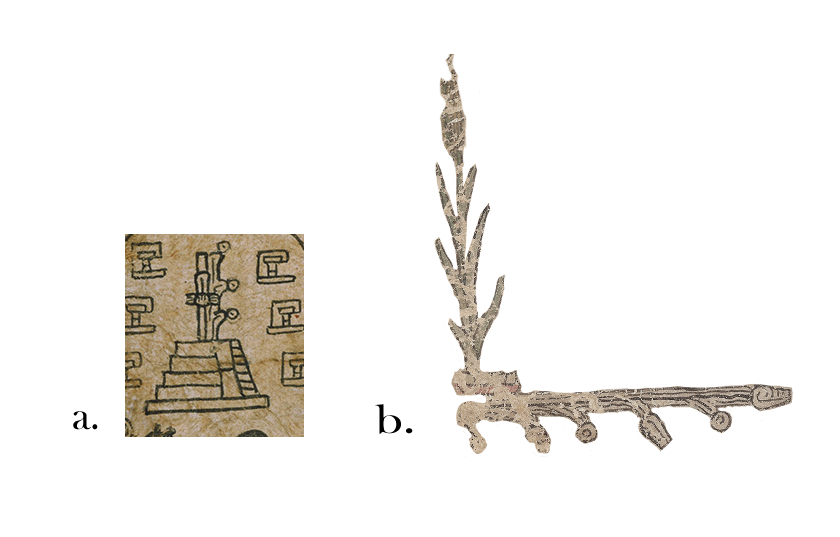
Indeed, the final confirmation for this reading, as well as the full details of this event from the point of view of the rebels, comes from Codex Huichapan, an Otomi codex. In the folio 52 of this document, the same event is represented, associated with the year 5 Reed of the Otomi calendar (Figure 4). The Otomi gloss gives us an insight on the actual location of this rebellion, and the true reasons for it: in fact, the rebellion started because the Aztec wanted the Otomi to drag a huge ahuehuete tree; however, the Huichapan Codex states that the tree would not budge after reaching Tlalnepantla: hence, they left a shield above the tree, and the rebellion started:

Quequa pintu mabagui anyänttoho queemuuti quütuy nucca ntza anqhuuttatzâ nucca hinpinettzi pahênibatho antzunmahoy chanubuu mambähenbi nucca ntza pahoxtho nucca mbuobây piyotho nucca mabagui nucco mënyänttoho cancatuy nuhna mabâgui nubayänttoho.

Here began the war in Chapa de Mota: it started with the rooted tree that could not be lifted, it only reached to Tlanepantla amid the lands, and when they came to take the tree further, they just laid a shield on it. The war with those of Chapa de Mota was re-started: thus began the war at Chapa de Mota. (Ecker 2003: 79).
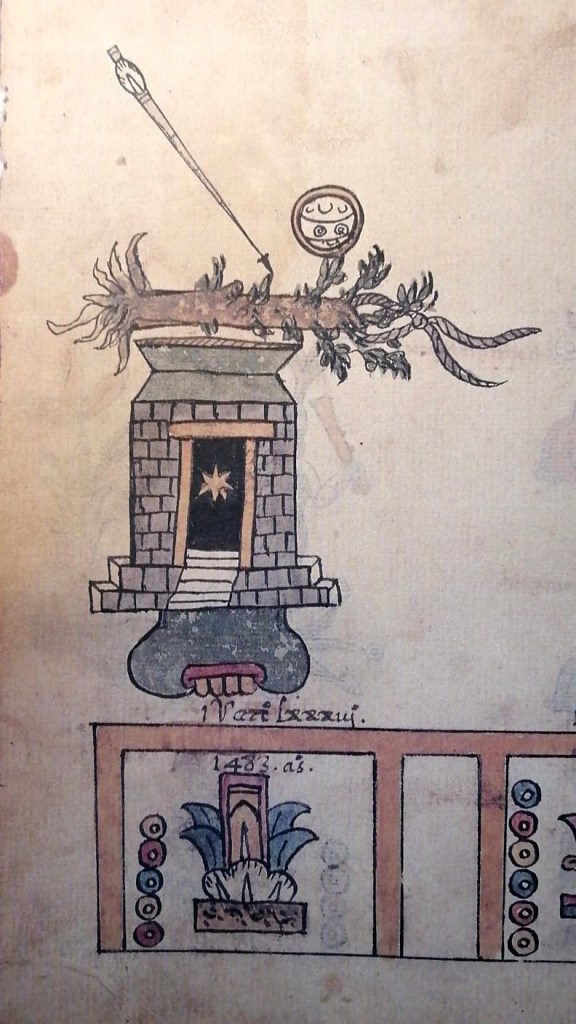
Figure 4. The rebellion at Chapa de Mota in 5 Reed (Codex Huichapan f52)

Finally, only the deer head remains mysterious. There are two possibilities. The first, considered by Barlow, is that it represents Tizoc’s conquest of Mazatlan (1949: 125), but the problem is that conquests in the Azcatitlan usually have the tepetl or ‘mountain’ sign denoting a polity or altepetl. Herren Rajagopalan’s recent study on the Boturini, Aubin and Azcatitlan offers an explanation which solves this problem in my point of view. This deer head is clearly incomplete, lacking the bottom part of its ‘frame line’: Rajagoplan suggests that it is an incomplete day-sign, and I agree that this is the most likely explanation in graphic terms (2018: 64). Probably, it states the day where the rebellion occurred. With all these elements, the passage is finally clear.

All things considered, this little bit of history doesn’t seem like much. But this exercise in interpretation tells us something important: the logic of Aztec tlacuillolli as a full communication system was overwhelmingly pictorial, and in it sometimes it can be actually difficult to ascertain the separation between ‘writing’ and ‘iconography’. We are left in the dark about the meaning of the whole when we consider the individual signs in isolation, to the point where we don’t really know if they are ‘iconography’ or ‘writing proper’: we need a historical context, transmitted to us through alphabetic glosses, to get a grasp of the nature of the signs and the ‘embedded text’ contained in them. This ‘embedded text’ probably roughly corresponded to the alphabetic account of the Anales de Tlatelolco, rather than to a text only produced by the reading of these signs as logograms. Of course, these assertions are conflictive with the current narrow definition of writing (Daniels 1996: 3), which specifically states that any system that needs the intervention of the original utterer (here, the tlacuilos ‘speaking’ through the alphabetic colonial versions of Aztec histories) to relay its full message is not writing, for writing is not considered as a mere assembly of signs but as the whole working of them. The dilemma is this: can tlacuilolli, taken as a whole rather than at the level of names, be considered as writing, or we need to continue using the split ‘iconography’ vs writing which doesn’t really correspond to the native categories, who lacked a word to distinguish logograms/syllabograms from “iconography”?

Regardless of the solution to this conundrum, which I cannot advance here, it must be said that the logic of these documents is dominantly ‘top-down’ rather than ‘bottom-up’: unlike in Maya writing, we gain little by the correct understanding of individual signs (as Barlow’s mistake makes evident), while contextual meaning is everything. It is also not always clear when something is “iconography” merely because of its appearance: the ‘war’ sign and even the beam sign, which denote something beyond mere names, or even more, can effectively double as “names” and “embedded texts”, proves it. In any case, the heuristics introduced by Dibble for this document still hold up, and can be used to our advantage in other obscure passages in Aztec writing: ‘attack’ the context as far as reliable parallel alphabetic sources permit it, and the signs will fall in place themselves; only after these possibilities are exhausted we can venture hypotheses based on analogies to known “pictographic” and logosyllabic signs. Of course, as mentioned, originally the source of this full reading was nothing else but that which Daniels calls ‘the original utterer’, that agent which in the perspective of current mainstream grammatology forbids Aztec writing from being considered ‘real writing’: a tlacuilo, a trained painter-writer in the historical tradition, which closed the gap between these signs and the reader and uttered for the readers a full message. But the answer to this question must be left for the future.

Acknowledgements

I want to thank Stan Declercq for facilitating me the relevant pages of Graulich’s edition of the Codex Azcatitlan. As in many other entries, I also want to thank Gabriel Kruell for reading this text and offering his views on it. He offers the following reading for the Azcatitlan: “Tizocicatzin was installed on the throne. In this year, he laid tezontle on the Temple of Huitzilopochtli. The inhabitants of Chiapan rebelled, wooden beams were brought from Itzmiquilpan, ahuehuete logs were dragged to serve as beams in the temple of Huitzilopochtli, but they didn’t want to work, they burned the ropes, and they mutinied”


References

Anonymous. 2004. Anales de Tlatelolco. Trans. Rafael Tena. Mexico: CONACULTA

Barlow, Robert. 1949. “El Códice Azcatitlán.” Journal de la Société des Américanistes 38: 101-135.

Beliaev, Dmitri. 2013. “Genesis of History Writing in Ancient Mesoamerica » in Dimitri Beliaev, and Timofey Guimon, eds. The Earliest States of Eastern Europe, 203-241. Moscow: Dmitriy Pozharskiy University.

Hill-Boone, Elizabeth. 2000. Stories in Red and Black. Pictorial Histories of the Aztecs and Mixtecs. Austin, TX: University of Austin Press.

Berlo, Janet. 1983. “Conceptual categories for the study of text and image in Mesoamerica”, in Janet Berlo, ed. Text and image in Pre-Columbian art. Essays on the interrelationship of the verbal and visual arts. Proceedings, 44th International Congress of Americanists, 79-118. Manchester, Oxford: BAR Publishing.

Chimalpahin, Domingo. 1998. Las ocho relaciones y el Memorial de Colhuacan. Trans. Rafael Tena. Mexico: CONACULTA.

Daniels, Peter T. 2006. “The Study of Writing Systems”. In Peter T. Daniels and William Bright, eds. The World’s Writing Systems, New York & Oxford: Oxford University Press, pp. 3-18.

Davletshin, Albert. 2003. Paleography of the Ancient Maya Hieroglyphic Writing, Ph.D. diss., Moscow: Russian State University for the Humanities, Knorozov Center of Mesoamerican Studies.

Dibble, Charles. 1981. Codex en Cruz. Salt Lake City, UT: University of Utah Press.

Ecker, Lawrence. 2004. Códice de Huichapan: Paleografía y traducción. Eds. Yolanda Lastra and Doris Bartholomew. México: UNAM.

Galarza, Joaquín. 1990. Amatl, Amoxtli. El papel, el libro. Los códices mesoamericanos. Guía para la introducción al estudio del material pictórico indígena. México: Tava.

Karttunen, Frances. 1983. An Analytical Dictionary of Nahuatl. Norman, OK: University of Oklahoma Press.

Lacadena, Alfonso. 2008. “Regional Scribal Traditions. Methodological Implications for the Decipherment of Nahuatl Writing.” The PARI Journal 8 (4): 1-22.

Rajagopalan, Angela Herren. 2019. Portraying the Aztec Past: The Codices Boturini, Azcatitlan, and Aubin. Austin, TX: University of Texas Press.

Tena, Rafael. 2004. Anales de Tlatelolco. México: Conaculta.

Thouvenot, Marc (2012). Tlachia [online]. National Autonomous University of Mexico <https://tlachia.iib.unam.mx/>

Wimmer, Alexis. 2004a. “Chiahuitl.” In Dictionnaire de nahuatl classique. https://gdn.iib.unam.mx/diccionario/chiahuitl/43696 (accessed 17 May 2021).

Wimmer, Alexis. 2004b. “ Chiyauhtlalli.” In Dictionnaire de nahuatl classique. https://gdn.iib.unam.mx/diccionario/chiyauhtlalli (accessed 17 May 2021).

Zender, Marc, Davletshin, Albert, Lacadena, Alfonso, Stuart, David, and Wichmann, Søren. 2013. An Introduction to Nahuatl Hieroglyphic Writing. 2013 Maya Meetings and Workshops, University of Texas, Austin. Austin, TX: University of Texas at Austin.


[1] Chiyahu(a): ‘To get something greasy’. Chiyahuac: ‘Something greasy, grimy, filthy’ (Karttunen 1983: 54). Chiyauhtlalli: Pantano (Wimmer 2004b).
A bloody marquess: On Hernán Cortés’ name and title in Nahuatl writing


Abstract:
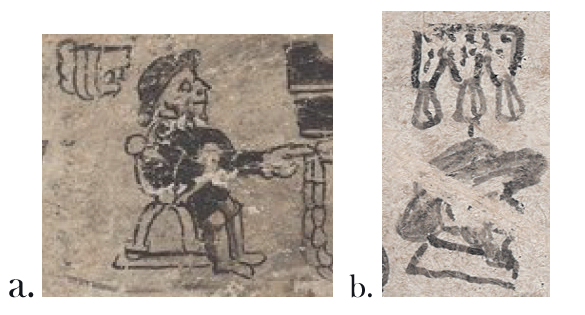
In this entry, I argue that Hernán Cortés had two glyphs denoting him in Nahuatl writing, both appearing in Codex Mexicanus: a) te, (Cort)és, Cortés, this glyph denotes his name; b) ez, (marqu)és, Marquess; this glyph denotes Cortés nobiliary title, and derives from the glyph EZ, eztli, 'blood', perhaps working in a syllabic way.

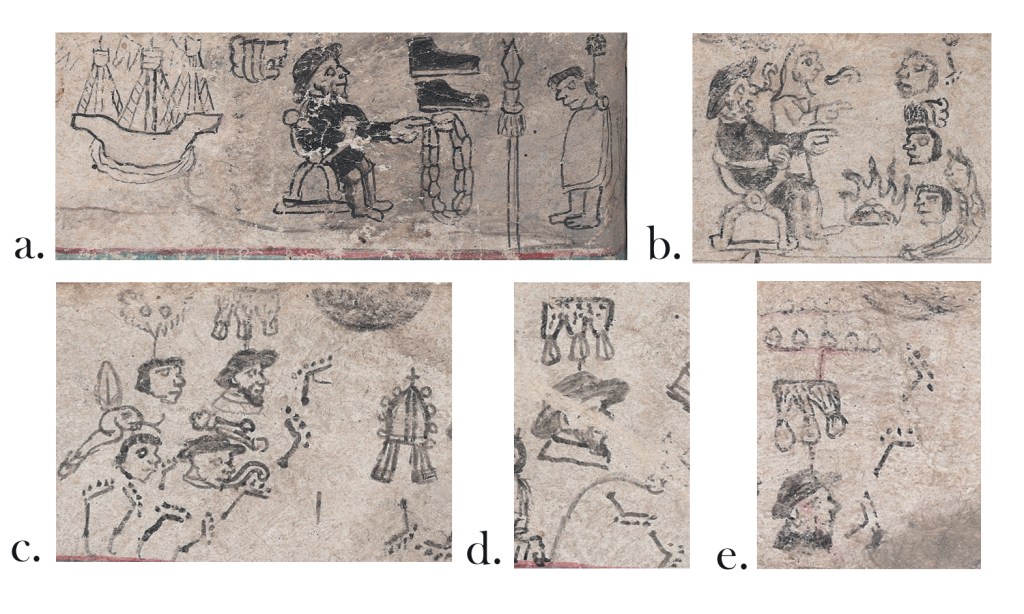
Despite his historical importance and being a familiar presence in Aztec colonial pictorials, the name of Hernán Cortés is a rare sight in Nahuatl writing. The conquistador is usually depicted with his name, or the title marqués, in alphabetic characters; iconographically, he is easy to recognize by the severe black garments that were de rigeur for any aspiring nobleman in the nascent Spanish empire, specially one of a dubious social standing, as he was. His iconography across many pictorials is quite consistent: completely black-clad, a feathered hat, and sitting on a Savonarola style Renaissance armchair (Figure 1).

Figure 1. Cortés’ iconography in Nahuatl pictorials: a) Codex Durán, meeting with the Tlillancalqui of Tenochtitlan; b) Lienzo de Tlaxcala, Texas fragment: meeting with Xicotencatl and Tlaxcalan nobility c) Florentine Codex, Book XII, another rendering of the meeting with Moctezuma’s envoys

Most Aztec colonial pictorials coincide in representing Cortés as nameless in terms of Nahuatl glyphs, not even depicting his title. The glyphic names of other Spanish conquistadors and imperials are better known, to the point of being nowadays textbook examples of Nahuatl strategies on the hieroglyphic representation of European names: Pedro Alvarado, called Tonatiuh by the Aztec, has a sun glyph as his name, read as TONA, Tona(tiuh), in Codex Telleriano Remensis 46r; another famous example is vicerroy Mendoza, rendered as me-TOZA, Me(n)doza. Similarly, Spanish titles are rather common in colonial Aztec writing: vicerroy, ix-e-EL, probably ix-le-e, (v)is(o)rrey; doctor, to-TOL, dotor; executor or factor: e-pa-TOL, e(l) fa(c)tor (cfr. Valle 2006). But what about Cortés, and his title, Marquess of the Valley of Oaxaca? Recently, a new edition of Codex Mexicanus, by María Castañeda de la Paz and Michel Oudijk (2019), has appeared. This late-style document still keeps many secrets for those passionate about Aztec writing. Among its oddities, this document clearly depicts Cortés with a name glyph in many, although not all, of his appearances: his meeting at San Juan de Ulúa (actually San Juan de Culhua, as Robert Barlow remarked, 1990: 218) with the Tlillancalqui, one of the great constables of Tenochtitlan, his travel to Spain in 1527 and his return in 1530, and his final departure from New Spain in 1540, never to return (Figure 2).

Figure 2. Cortés in Codex Mexicanus: a) Cortés meets with the Tlillancalqui, page 76; b) Cortés, nameless, meets the Aztec captains: Cuauhtemoc, Motelchiuhtzin and the Cihuacoatl, page 77; c) Cortés departs to Spain alongside Nezahualtecolotzin, Coatlhuitzilihuitl, and an still undeciphered Spanish companion, page 78; d) Cortés returns to Mexico, page 78; e) Cortés departs to Spain, never to return, page 80.

Let’s concentrate on the couple of glyphs that denotes Cortés, which are not without their particular problems; first, that which denotes his fated meeting with Moctezuma’s envoys (Figure 3). Mengin suggested it was the nameplace of Tecpan Tlayacac (1952: 463), but it doesn’t resembles the appearance of this toponym in Tepetlaoztoc 4b, and we know the meeting was instead in San Juan de Ulúa; Boornazian Diel suggests a resemblance to the glyph of Tecamachalco in Codex Mendoza 42r, and a phonetical assimilation from CAMA-te to Cortés (2018: 141). Finally, Castañeda de la Paz and Oudijk considered that the name is indeed Cortés’ name, rather than a toponym, but offer no solution to its reading. It seems that the solution is perhaps anticlicmatic; the name probably reads: te, (Cor)te(s), Cortés, presenting the tentli+tetl variant of the syllabogram te. Regarding the first possibility, this kind of extreme abbreviation was not unknown in Nahuatl writing: another amusing example is that of Cepatzac, abbreviated to ce in the Matricula de Huexotzinco 387_838v. Before moving on, another thing must be added on the envoy of Moctezuma depicted here. It has been suspected that this glyph denotes the envoy that Bernal and Cortés called Tendile (sic), or Tentlil in Nahuatl according to Sahagún (Castañeda de la Paz and Oudijk 2019: 171), but given the gloss in the Durán Codex that calls the same character Tlillancalqui (see Figure 1), I consider it more probably that the tlilli, ‘black ink, soot’ glyph denotes the title rather than the name.

Figure 3. Cortés, probably rendered as te, (Cor)té(s), meets with the Tlillancalqui of Tenochtitlan, rendered as TLIL, Tlil(lancalqui). Codex Mexicanus 76.

More complicated, in both an iconographic and epigraphic perspective, is the couple of scenes depicted at page 78. Commentators on the Mexicanus have long known that these scenes depict Cortés’ travel to Spain in 1528 alongside Aztec noblemen and lords, and his return in 1530 (cfr. Mengin 1952: 471-474; Castañeda de la Paz and Oudijk 2019: 177; Diel 2018: 148). Cortés has here another name sign that denotes him: dubbed trois gouttes d’eau qui tombent by Mengin (1952: 473) and ‘rain’ by Diel (2018: 147), the sign is rather close iconographically to the glyph QUIYAUH, quiyauh, ‘rainstorm’. A reading for glyph has been elusive. Mengin was doubtful between attributing it to Cortés or considering it a ‘viceregal’ glyph of sorts (1952: 473). Diel proposes that, somehow, QUIYAUH could have been assimilated to the Spanish marqués, but she doesn’t offers an explanation for this assimilation, although I believe her identification to be correct (2018: 143). María Castañeda de la Paz and Michel Oudijk concede they have no possibilities in mind for its reading (2019: 177). On close examination, the answer seems to lie in an aspect of Nahuatl writing that is unevenly depicted in Codex Mexicanus: colour. Thus, while this glyph is certainly iconographically certain to QUIYAUH, it is not actually it. Instead, this glyph closely resembles that at Mendoza 65r, which appears in the spelling of the title Ezhuahuacatl, one of the great constables of the Aztec empire (Figure 4)

Figure 4. a) Cortés glyph (Codex Mexicanus 78) b) Ezhuahuacatl title (Codex Mendoza 36r)

The Ezhuahuacatl glyph is rather intriguing. It is clearly depicts a ‘blood-sign’ iconography, being a red liquid with green jade dots, for blood was a precious liquid. But what about the stripped pattern? A colleague, Gabriel Kruell, suggested me that this pattern could be an allusion to huahuana, “to scratch, scrape, to incise lines”. Hence: EZ-hua, ezhua(huacatl), Ezhuahuacatl. And Cortés? Cortés could be a case where EZ is working here perhaps in a syllabic way, as ez, deviating a bit from its standard reading. Anomalous, but given the still obscure processes by which foreign names were rendered into Aztec writing, it is not improbable. In any case, the real question is the following: is this glyph the name Cortés, or marqués, his title? Technically, it is impossible to know, but what is certain is that the ez glyph reappears associated to Hernan’s Mestizo son, Martín, in the following pages (Figure 5).

Figure 5. Martín Cortés in the Codex Mexicanus: a) Arrival alongside Jerónimo de Valderrama, page 84; b) Execution of his supporters, the Dávila brothers, and exile, page 85.

Indeed, the ez glyph reappears multiple times in the latter portions of the Mexicanus, this time associated with the events of Martin’s life. It appears at his arrival with the visitador Jerónimo de Valderrama (another epigraphic nightmare) in 1563, at the execution of the Dávila brothers, his supporters, in 1566, and at his exile in 1567. The glyph is undoubtly his, but the problem is that Martín Cortés was both a Cortés and a marquess, like his father was. However, my hunch is that Diel was right, and despite this lack of certainty, the ‘blood’ glyph ez is actually marqués, because the glyph for Cortés already appeared before, and this name glyph changes just after Cortés started styling himself after a nobility title which was specially favoured to denote him in retrospective indigenous chronicles like Codex Aubin, where nothing is said about the arrival of Cortés nor of his exploits, but rather about those of the marqués (cfr. Tena: 2017: 55ff.). In any case, this ominous ‘blood glyph’ is oddly appropriate, not only because of the amount of human suffering that Cortes’ actions and the European colonization of the Americas brought, but also because of the bloody execution of his son’s supporters, and the tragic end of his son himself, who was tortured before dying in exile in 1589.

Acknowledgements

Again, I want to thank Gabriel Kendrick Kruell for his comments on the idea of this note. All opinions presented here are mine alone.

References

Barlow, Robert. 1990. Algunas consideraciones sobre el término “Imperio Azteca”. In Obras de Robert Barlow, eds. Jesús Monjarás-Ruiz, Elena Limón, María de la Cruz Paillés. 213-220. México: INAH/UDLA

Diel, Lori Boornazian. 2018. The Codex Mexicanus: A Guide to Life in Late Sixteenth-Century New Spain. Austin, TX: University of Texas Press.

Castañeda de la Paz, María, and Michel Oudijk. 2019. El Códice Mexicanus. México: Universidad Nacional Autónoma de México.

Mengin Ernest. 1952. “Commentaire du Codex mexicanus n° 23-24 de la Bibliothèque Nationale de Paris.” Journal de la Société des Américanistes 41 (2): 387-498.

Tena, Rafael, 2017. Códice Aubin. Vol. II. Facsimile edition. Mexico: INAH.

Valle, Perla. 2006. “Glifos de cargos, títulos y oficios en códices nahuas del siglo XVI.” Desacatos 22: 109-118. 

Return to Aztlan: A glyph reconsidered

Abstract
The mysterious glyph for Aztlan is probably a case of non-initial phonetic motivation in Aztec writing, a phenomenon first noticed by Gordon Whittaker. The iconographic identification of the glyph is piaztli, 'drinking straw'. The reading proposed here for its appearance in Codex Boturini is: az, Az(tlan), Aztlan.

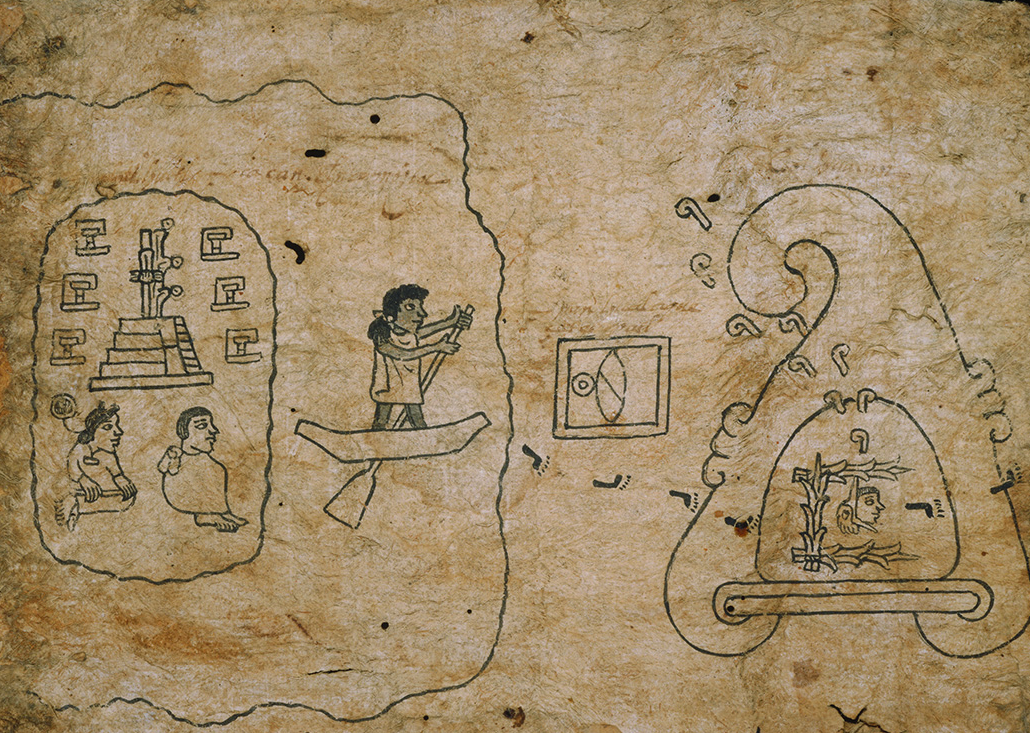
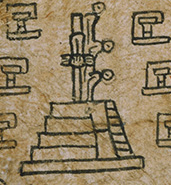
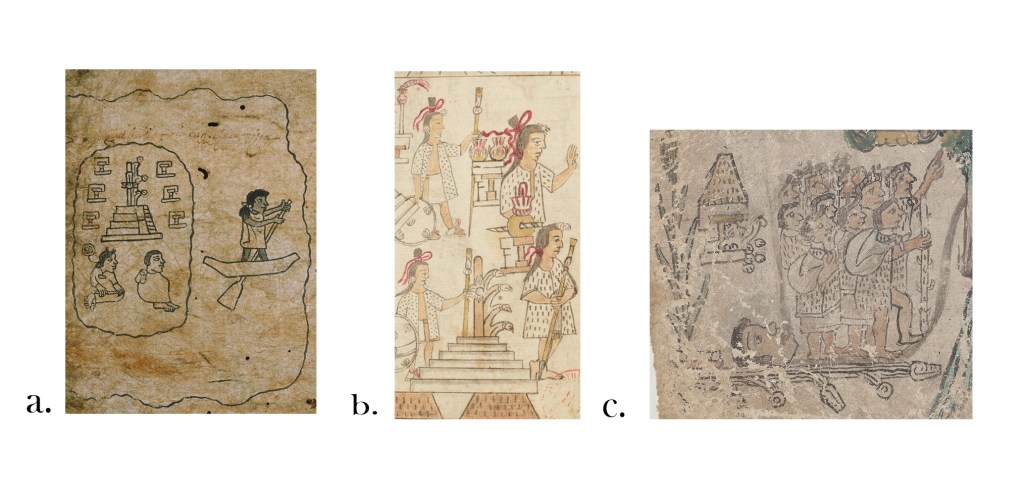
One of the most enduring enigmas in Aztec epigraphy is the reading of a glyph that figures at the very first folio of the Codex Boturini, within the famous scene that depicts the departure of the Aztec from their homeland, Aztlan (Figure 1). This glyph, standing atop a temple in the midst of the island where Aztlan was thought to be, reappears in a depiction of the same scene at Codex Azcatitlan 2r, and seems to be formed by a reed (acatl) or arrow (mitl) sign with a water (atl) sign; thus, it has been dubbed as the ‘reed-water sign’ (Herren Rajagoplan 2019: 29). A third version of this departure scene appears at Codex Mexicanus 18, where an arguably equivalent version of this glyphic compound is formed by a reed sign, a teeth (tlantli) sign, and a water sign.

Figure 1. The departure from Aztlan. a) Codex Boturini 1; b) Codex Azcatitlan 2r. c) Codex Mexicanus 18. The teeth sign, barely visible, is below the reed to the left and above the water sign.

Given the content of this scene and its parallels in Codex Aubin 3r, it has been natural to consider this glyph as the place name for Aztlan, as Eduard Seler originally proposed it (1960: 31). However, Seler’s analysis of the glyph as a water sign atl (today read as the syllabogram a) plus a depiction of a white reed or aztapilli, is problematic, given the fact that this particular rendering of a reed never reappears associated to the reading aztapilli in the extant Aztec hieroglyphic corpus. The first scholar to suggest that this glyph was not an Aztlan glyph, proposing an alternative explanation, was Robert Barlow, in his facsimile edition of the Codex Azcatitlan. According to Barlow, the glyph would better be read as the name of Amimitl, a Chichimec god of hunting and fishing (1948: 38), thus making this glyph read as a-mi, Ami(mitl), if we were to render Barlow’s reading according to current conventions (cfr. Lacadena and Kettunen 2014).

Barlow’s explanation has been recently upheld by scholars such as María Castañeda de la Paz (2007: 187), and is plausible indeed. However, the main difficulty in Barlow’s interpretation arises from the fact that the glyph reappears in folios 3 and 4, associated with a human character, rather than a god (Figure 2). When compared with alphabetic versions of these episodes, such as those present in Codex Aubin, folio 3 of Codex Boturini seems to deal with the separation of the Aztec from the rest of the calpulli that accompanied them (Huexontzica, Chalca, Xochimilca, Cuitlahuaca, Malinalca, Chichimeca, Tecpaneca and Matlatzinca), an episode which ocurred after the ominous fall of a sacred tree (cfr. Tena 2017: 37), while folio 4 seems to deal with how the Aztec ceased to use their original ethnonym after sacrificing the mimixcoa: Xiuhneltzin, Mimichtzin and his sister (cfr. Tena 2017: 37). Furthermore, the god Amimitl plays no role in the Mexica pilgrimage in any of the extant alphabetic versions; instead, Tezozomoc says that it actually was the temple of Huitzilopochtli which was located at Aztlan (2003: 53). An alternative explanation has been offered for this: the priest depicted in the Boturini is also called Amimitl, he was a prominent leader of the Aztec pilgrimage, and his name has been ommited from alphabetic renderings of this story (cfr. Castañeda de la Paz 2005: 18). Not all scholars agree with the existance of a priest called Amimitl, nor with the relevance of the god Amimitl at Aztlan; for example, the recent study on the Boturini, Aubin and Azcatitlan codices by Angela Herren Rajagoplan upholds Seler’s original reading (2019: 17). Another argument against the a-mi reading is the parallel with the Mexicanus version: there, the ‘reed-teeth-water’ glyph obviously refers to a place rather than a god, since people seem to be ‘coming out’ of a human face placed above the sign, perhaps a personified cave or mountain, making the ’emergence’ narrative more explicit.

Figure 2. The ‘water-reed’ sign associated to human characters in diferent episodes of Codex Boturini: a) The separation of the Aztec from the other tribes, folio 1; b) The sacrifice of the mimixcoa, whose names are read as XIUH, Xiuh(neltzin), and MICH, (Mi)mich(tzin); the third character is unnamed (folio 2).

Is there a way to surmouth this difficulty? I think there is one, although it involves a proposal that is still incipient in Aztec epigraphy. In 2009, Gordon Whittaker presented a now famous analysis of an equally conflictive glyph: that of Chipiltepec, which occurs in Codex Tepetlaoztoc f. 5r (Figure 3). The curious thing about this glyph is that it is formed by the apparent sequence chi-HUIPIL-te-TEPE, but is glossed as Chipiltepec in the document. Whittaker suggested that in this case the huipilli sign is not to be read as the logogram HUIPIL, huipil, ‘blouse, shirt’, but instead as the syllabic sequence pil. Thus, the reading would be chi-pil-te-TEPE ( Whittaker 2009: 63); effectively, this reading implies omitting the first part of the huipilli sign from the reading.

Figure 3. The place name Chipiltepec, read as chi-pil-te-TEPE, Chipiltepe(c) <gloss: chipiltepec> (Codex Tepetlaoztoc f. 5r).

Whittaker’s suggestions have been subject to a strong debate and met some reservations. Mainly the problem is how to properly conceptualize this non-initial phonetic derivation in Aztec writing and, also, finding more examples to substantiate it. At a recent presentation (2021), Whittaker has proposed to call this mechanism ‘hysterophonic derivation’, or phonetic derivation from the middle/final rather than the initial part of the word; this would be (if I am not misunderstanding) more or less the opposite of the process denoted by the word acrophony. Whittaker’s book on Aztec writing is forthcoming next month, so I hope that more on this writing resource will be found there. To this nowadays famous example I could add that perhaps it is not impossible to find examples of non-initial motivation in Aztec signs. A possible instance of a similar phenomenon is the syllabogram yo (Davletshin 2013, in Lacadena and Kettunen 2014: 12), which seems to derive graphically from the coyolli (‘bell’) sign, ommiting the initial syllable from the reading.

But what about Aztlan, the subject of this blog entry? What I think is that Aztlan could be yet another case of this yet not completely understood derivation mechanism. Some years ago, the philologist Patrick Johansson noticed that the ‘reed-water’ glyph at Codex Boturini was rather similar to the place glyph of Piaztlan, ‘place of long squashes’, derived from piaztli, a word which also meant a cane straw for drinking, at Codex Mendoza f. 15v, although he only offered this iconographic identification as a possibility, considering phonetic assimilation as the plausible explanation (2016: 130). I consider that Johansson’s iconographic identification is correct. Indeed, besides adding new historical characters and temples to the Aztlan story, the problem with the mi reading in this context is that sign lacks its characteristic arrowtip; when missing it, this sign is usually read as TLACOCH, ‘spear, dart’. Instead, the Aztlan glyph seems to be closer to the depiction of a drinking straw at the Mendoza, as well as other depictions of drinking straws in Mixteca-Puebla art, such as that found in Codex Borgia lam. 45, where the glyph is associated to the ritual drinking of pulque (Figure 4). These straws are depicted as dried reeds adorned with feathers, joined to water or pulque.

Figure 4. The Piaztlan sign and its iconographic motivation: a) PIAZ, Piaz(tlan), ‘Place of drinking straws’ (Codex Mendoza 15v); b) A piaztli or drinking straw atop a pulque vessel (Codex Borgia 45).

But what about the actual reading of the ‘water-reed’ glyph? If we were to follow Whittaker’s suggestion regarding the non-initial motivation of certain phonetic readings in Aztec writing, then the logogram PIAZ, piaz(tli), ‘long squash, drinking straw’, represented as a reed in both Aztec and Mixtec iconography, would be subject to non-initial phonetic derivation here, and yield the reading value az, thus obtaining the full reading az, Az(tlan), ‘Aztlan’. This proposal would make sense in all the contexts on which this sign appears, given that it seems to work both as a place name in folio 1, and as an ethnonym in folios 3 and 4. For example, another clue to understand this sign as both a place name and an ethnonym comes from the textual parallel of folio 4 of Codex Boturini with the alphabetic account found in Codex Aubin; the text of the latter states that, after the sacrifice of the mimixcoa, the Aztec stopped using this ethnonym and started calling themselves Mexica. Thus, the PIAZ/az glyph dissapears from the pictorial account of the Boturini just at the same point as the name Aztec does from the alphabetic accounts of the Mexica pilgrimage. The reading could also fit with the variant that appears at the Codex Mexicanus (Figure 4), if we conceive the tla glyph as infixed in this compound; the ‘drinking straw’ sign would be iconographically represented by the depiction of a complete reed plant atop water, an iconographic ambiguity present in other instances of the ACA, aca(tl) ‘reed’ sign, which varies between a depiction of a dried, cut cane adorned with feathers, and the plant itself, still green (cfr. Lacadena and Kettunen 2014: 31), and which could be extended to the PIAZ/az sign.

Figure 4. The Aztlan toponym: az, Az(tlan) a) Codex Boturini f. 1; b) Codex Mexicanus, where the tla would be infixed, and the cane glyph would be even more naturalistic, giving the reading a-az-tla, Aztla(n).

As it is well known, Aztlan doesn’t have an agreed etymology, presenting up to five different proposals in the sources alone (cfr. Navarrete Linares 2011: 104-106). A colleague, Gabriel Kruell, recently suggested to me that this would be because Aztlan could be a Nahuatl rendering of a non-Nahuatl word; for example, Ixtlilxochitl mentions that Nahuatl was not the original language of the Aztlaneca or inhabitants of Aztlan (1891: 106). If this is the case, perhaps this could explain that the written form of this name would be hesitant to use a better-known glyph, like the glyph AZTA, azta(tl), ‘heron’, to convey the az syllabic sequence.

Of course, the main problem with this proposal is the need to further our understanding of these apparent non-initially motivated signs in Aztec writing, as well as other similarly anomalous signs. Unlike regular syllabograms, these examples seem to be mostly hapax in nature, and in the case of pil seem to admit a rather uncommon CVC structure. Furthermore, unlike yo, examples like az or pil don’t seem to be that relevant for the currently accepted syllabic grid, which is composed by signs that appear as syllabograms in a systemic, predictable fashion (cfr. Kettunen and Lacadena 2014); perhaps, then, if they become accepted, these anomalous readings could be integrated into the entry for their respective ‘parent’ logograms rather than into the ‘main’ syllabic grid. In any case, given the lack of agreement on how to analyse these glyphs or whether to accept these exceptional cases of non-initial derivation, I propose this reading as a tentative suggestion rather than as a fact, but I find it to be the most satisfying interpretation for me at the moment, since it doesn’t incorporate any new elements to the known historical narrative, and instead just ammends a bit our understanding of how this particular sign was read in this context.

Acknowledgements

I want to thank Dr Gabriel Kenrick Kruell for his comments on this idea, and for his encouragement on disseminating it. All opinions stated here are mine alone.

Addendum

Having finally read Whittaker’s recent (and important) book on Aztec writing (2021), it is perhaps surprising that this fascinating glyph is merely mentioned in passing there, but the implicit analysis is the same (not surprising, of course, given that my analysis was inspired by Whittaker’s work in the first place): “A histerophonic value (is) a phonetic value derived, not acrophonically from the initial section of a word base or logogram, but hysterophonically from its final section. Examples of this of Aztec date are pil from HUIPIL(LI), “blouse”, az from PIAZ(TLI), “water pipe”, and hua3 from IZHUA(TL), “leaf” (Whittaker 2021: 190). I believe that the fact that in three different occasions, which is Johansson (2016), this note from 2021, and Whittaker’s book, published a month after (2021), the same explanation has been given to this sign, makes the case for it being the correct interpretation rather strong. Finally, I must say that, personally, I do not claim any precedence on this analysis, since the first to identify correctly the iconography of the glyph was, to my notice, Patrick Johansson, and Gordon Whittaker’s explanation of the mechanism behind it takes precedence over this note; however, given the importance of this glyph for the history of the people who are still known as Aztecs in the majority of languages of the world, I felt it was necessary to develop the argument in extenso.

References

Barlow, Robert H. 1949. “El Códice Azcatitlan”. Journal de la Société des Americanistes 38: 101-135. Facsimile edition, Paris.

Castañeda De La Paz, María. 2010. “El Códice X o los anales del grupo de la Tira de la Peregrinación. Evolución pictográfica y problemas en su análisis interpretativo”, Journal de la Société des américanistes 91(1): 7-40.

Castañeda de la Paz, María. 2007. “«La Tira de la peregrinación y la ascendencia chichimeca de los tenochca.” Estudios de Cultura Náhuatl 38: 183-212.

Ixtlilxochitl, Fernando de Alva. 1891. “Las naciones que hubo en la Nueva España y hasta hoy en día, y las lenguas que usa cada nación” In Obras Históricas, Tomo 1: Relaciones, ed. Alfredo Chavero, 106-109. Mexico: Oficina Tipográfica de la Secretaría de Fomento.

Johansson, Patrick. 2016. “La imagen de Aztlan en el “Códice Boturini.” Estudios de Cultura Náhuatl 51: 111-172.

Lacadena, Alfonso, and Harri Kettunen, 2014. Sistemas de escritura mesoamericanos: Escritura náhuatl. Manual for the Workshop organised at the University of Helsinki, March 17-April 2.

Navarrete, Federico. 2011. Los orígenes de los pueblos indígenas del valle de México: Los altépetl y sus historias. México: Universidad Nacional Autónoma de México / Instituto de Investigaciones Históricas.

Seler, Eduard. 1960. Gesammelte Abhandlungen zur Amerikanischen Sprach- und Altertumskund, vol 2. Graz: Akademisehe Druek- u. Verlag-sanstalt.

Rajagopalan, Angela Herren. 2019. Portraying the Aztec Past: The Codices Boturini, Azcatitlan, and Aubin. Austin, TX: University of Texas Press.

Tena, Rafael. Códice Aubin. Edición facsimilar, vol. 2. México: Secretaría de Cultura / Instituto Nacional de Antropología e Historia.

Tezozomoc, Hernando de Alvarado. 2003. Crónica Méxicana. Madrid: Promolibro.

Whittaker, Gordon. 2009. “The Principles of Nahuatl Writing.” Göttinger Beiträge zur Sprachwissenschaft 16: 47‐81.

Whittaker, Gordon. 2021. “The Controversial Relationship between Aztec Iconography and Writing.” Presentation at the INSCRIBE Workshop, Production of Images and Language Notation, Zoom, 12-15 January.

Whittaker, Gordon. 2021. Deciphering Aztec Hieroglyphs: A guide to Nahuatl writing, Berkeley: University of California Press.

Welcome

Tlacuilolli means both ‘painting’ and ‘writing’ in Nahuatl, the language of the Aztec. In a way, the problematic ambiguity implied by this word and its equivalents in other Mesoamerican languages will be the central topic of this blog. In this space I will present some of my thoughts on Mesoamerican writing systems (Aztec, Maya, Mixtec, mainly), as well as some reflections on the former and current debates on the topic. Occassionally, non-Mesoamerican record systems of the Americas will be featured here. The content presented here is provisional, since I am an independent enthusiast rather than an expert, so any feedback on it is more than welcome. More updates coming soon!