The sacred precinct in Primeros Memoriales: What does writing tells us?

Alonso Rodrigo Zamora Corona

Abstract: The famous plan of the teoithualco or sacred courtyard in folio 269r of Sahagun’s Primeros Memoriales has been of enormous importance in conceptualizing sacred spaces in Aztec religious history and archaeology, despite the uncertainties regarding its identification. This note argues that the most famous interpretation of this diagram, that of Eduard Seler (1901), probably misidentified two buildings, namely the Colhuacan Teocalli or ‘Temple of Culhuacan’ and the Cuauhcalli or ‘House of Eagles’, a temple for warriors. This misidentification stemmed from glossing over the CUAUH, cuauh·tli, ‘eagle’ glyph next to the small temple-house with the image of Huitzilopochtli, as well as from Seler’s usage of Durán’s information regarding the location of the cuauhcalli, now superseded by archaeological data.

Perhaps the most famous pictography in Sahagun’s Primeros Memoriales is the representation of what this document calls cececni tlacatecolocalco, ‘many temples of the devil’, a Christian misnomer of what probably was cececni teocalco or ‘many temples of the gods’. This image, one of the few extant indigenous diagrams of a ritual compound in in XVIth century Central Mexico (others are to be found in the Plano de Papel de Maguey and arguably in Codex Borgia), is precious for its alphabetic glosses but, sadly, each of the items of the image is not correlated with certainty with its accompanying list. The first scholar to attempt this work of identification was Eduard Seler, in an article “The Excavations at the Site of the Main Temple of Mexico” (1901), dedicated to recent findings in the Historical Centre of Mexico City. Most of these identifications, which presupposed that the diagram was indeed that of Tenochtitlan’s sacred precinct, have stood firmly the test of time (Figure 1). However, there is an element, or perhaps a couple of them, which are controversial (see Sahagún 1997: 117-120), and which Seler himself considered as not as certain (nicht mit gleicher Sicherheit) as the rest: I am referring to his identification of the structure at the top of the diagram (or to the east, since indigenous maps were oriented towards that direction) with the Colhuacan Teocalli, and that at the bottom left of the diagram (North West) with the Cuauhcalli, the ‘house of eagles’, a military temple.
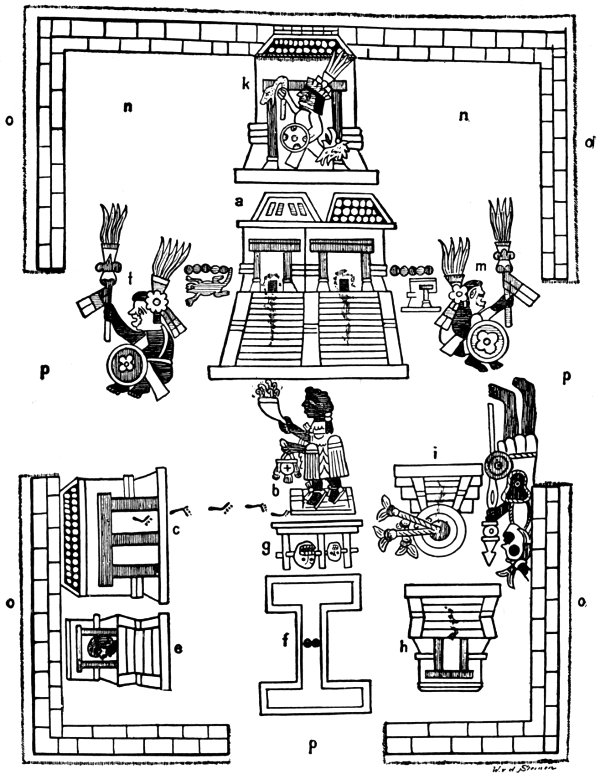
Figure 1. Sahagun’s plan of a sacred precinct and its identifications according to Seler (1901): a) The two great temples; b) The cuauhxicalli or ‘eagle bowl’, an altar to the sun; (c) A calmecac, priest houses; e) The Cuauhcalli or ‘house of eagles’, a temple for warriors; (f) The teotlachtli or ‘ball court of the gods’; g) Tzompantli or skull rack; h) Yopico Teocalli, the temple of Xipe Totec, the flayed god; i) The temalacatl, where the ‘gladiatorial’ sacrifice or tlahuahuanaliztli took place; k) The Colhuacan Teocalli or ‘temple of Colhuacan’, which Seler identified as a Huitzilopochtli temple; l, m) The gods 5 Lizard and 5 House respectively; n) The ithualli or courtyards; o) The coatenamitl or ‘snake wall’.
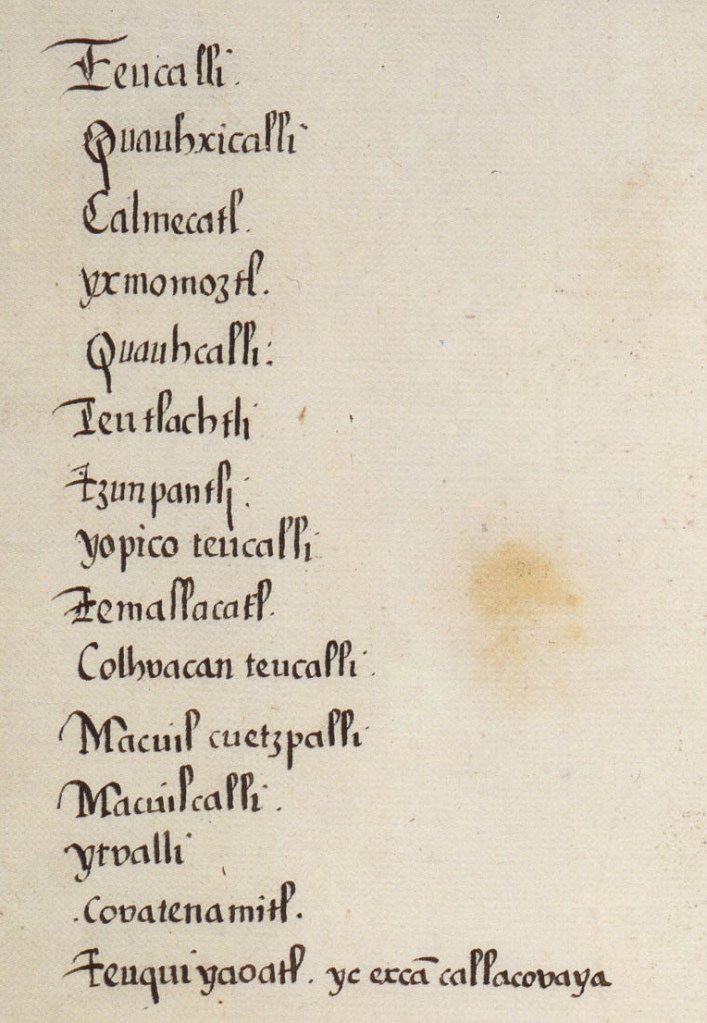
Figure 2. The original list in Primeros Memoriales: <gloss: Teucalli. / Quauhxicalli. / Calmecatl. yxmomoztl. / Quauhcalli. / Teutlachtli. / Tzunpantlj. / Yopico teucalli / Temallacatl. / Colhvacan teucalli. / Macuilcuetzpalli / Macuilcalli. / Ytvalli. / Covatenamitl. /Teuquiyaoatl. Yc excā callacovaya> Translation: “House of the gods / Eagle vesssel / Priestly school / Front platform altar / Eagle house / Sacred ball court / Skull rack / Yopico Temple / ‘Gladiatorial’ stone / Colhuacan temple / Five Lizard / Five House / Courtyard / Wall of snakes / Sacred portals, entryways in three places” (cfr. Sahagún 1997: 119-120).

Before dealing in depth with the topic of this note, namely, whether Seler’s identification of the cuauhcalli with temple e in his diagram can be still upheld, an important warning must be made. As Thelma Sullivan explains in his edition and translation of this Sahaguntine document (1997), we don’t know whether this scheme depicts either a diagram of the sacred precinct of Tenochtitlan, as many have assumed (Marquina 1960, 1964 ; González Torres 1985: 153-171 ; León-Portilla 1987a: 84-87 ; Townsend 1987: 372, 2010: 133; Matos Moctezuma 1999: 27; López Austin 2009: 32; Couvreur 2002), or an image of the sacred precinct of Tepepolco/Tepeapulco, the provincial town where Sahagun started his researches on Aztec religion, and from which the now lost pictographies that were put into text in order to create the Primeros Memoriales proceed, an opinion shared by H.B. Nicholson (cfr. Sahagún 1997: 117-120), Eloise Quiñones Queber (cfr. Sahagún 1997: 39), and Santiago de Orduña (2008). Indeed, the Primeros Memoriales stemmed from a questionnaire distributed by Sahagún among the old men of Tepepolco, in a way that has been compared (but cannot be equalled) to modern ethnology. The tlamatini or wise men in town, which did not use alphabetic writing, responded with a mixture of pictographies and logosyllabic writing, which were later re-copied and ‘translated’ into an alphabetic text, sometimes, but not always, illustrated with copies of the Tepepolcan pictographies, a work which was done by Sahagun’s Tlatelolcan students. This alphabetic ‘translation’ and redrawing is what we have today, since the non-alphabetic originals made by Tepepolcan tlacuilos, expressly recalled by Sahagun as having being in his possession many years later, are now lost (cfr. León Portilla 1999: 123-134).

            Furthermore, a third possibility exists, which Sullivan also contemplates: that this diagram was simply an idealized image of the cececni teocalco or many houses of the gods, as they were expected to exist in towns that shared (more or less) the religious cults of the Mexica-Tenochca, such as Mexico-Tlatelolco or Tetzcoco. This question is unsolvable for now, and I won’t attempt to offer any definitive solution to it. Instead, I am going to concentrate on a feature of the diagram that has been generally ignored by the commentators: the glyph CUAUH, cuauh·tli, ‘eagle’ right next to the building that Seler identified as the Colhuacan Teocalli or ‘Temple of Colhuacan’ (Figure 3).
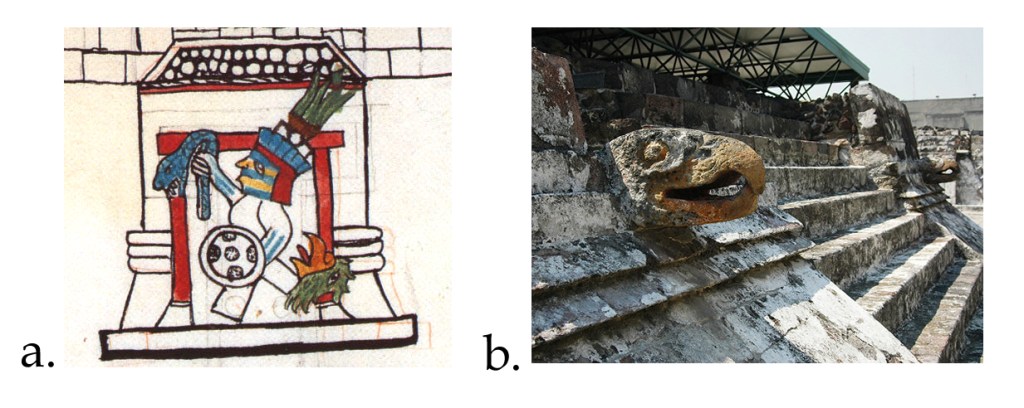
Figure 3. a) The House of Eagles in the Primeros Memoriales 269r. Notice the CUAUH or ‘eagle’ logogram in it; b) Eagle heads at the archaeological remains of the cuauhcalli, north of the main temple or huey teocalli.

From what we know nowadays about Aztec writing, this glyph is undoubtedly a logogram, and it works as a concrete label, which denotes a word beginning with the root cuauh, ‘eagle’. However, since Aztec writing was fond of abbreviations or elisions, this glyph can be correlated with two of the words of the list of the informants of Sahagun: the cuauhxicalli or ‘bowl of the eagles’, and the cuauhcalli, or ‘house of the eagles’. In fact, it could be argued that this glyph transforms the temple into a sort of logogram too, and that it must be read CUAUH-CAL, cuauhcall(i), ‘house of eagles, given the fact that, being a label rather than just an iconographic element, it can only name the temple itself, given the fact that no cuauhxicalli (a circular stone above a momoztli or altar) is in sight. Of course, this would be natural, since the real archaeological cuauhcalli had two eagle heads in its frontispice, which also must be read, as many elements in Aztec art, as a sort of label, as writing.

Of course, the reader would notice that, if we were to identify the cuauhcalli with the temple at the north, the label Colhuacan Teocalli would be missing its identification. Sadly, the Colhuacan Teocalli is a structure that appears nowhere in the extant information regarding Aztec culture gathered by the friars in the sixteenth century. It is missing from Sahagun’s list of the sacred buildings at the sacred precinct of Tenochtitlan, which comprised 78 edifices (Sahagun 1981: 179-193). Because of this missing information, Seler had to propose that the Colhuacan Teocalli was a temple of Huitzilopochtli represented at his original mountain abode at Colhuacan, as depicted in the first page of Codex Boturini, from which the Aztec departed in the year 1 Flint according to Codex Aubin (Tena 2017: 34). However, the main problem is that, as stated, the glyph CUAUH associated to this depiction must be necessarily assigned to some place in the list: where that to be the case, then the cuauhxicalli would have been associated with this purposed temple, something that contradicts all extant information regarding these structures, given that the cuauhxicalli was located in a separate courtyard, in a building called cuauhxicalco, next to the temalacatl (cfr. Durán 2002: 106; Sahagún 1981: 48) which is now hypothesized to have been located in front of the huey teocalli (López Luján and Barrera Rodríguez 2011).

If we reject the identification of k in Seler’s scheme with the Colhuacan Teocalli, then the only other place where this temple was would be what he considered as the cuauhcalli, or e in his diagram (Figure 1). This structure, as Sullivan indicates, is clearly a temple for Cihuacoatl, the warrior goddess, called inantzi teteo or ‘mother of the gods’ in the Primeros Memoriales (Sahagún 1997: 123), identified by her facial painting, half red, half black (cfr. Sahagún 1997: 105). In the hymn dedicated to this goddess, also in the same manuscript, she is called colhoa, ‘she of Colhuacan’, as well as imaza Colhuacan, ‘the deer of Colhuacan’ (Sahagún 1997: 144). It is therefore possible to sustain the idea that the Colhuacan Teocalco was a temple for this goddess, rather than a representation of the cave of Quinehuayan in Colhuacan, the Urheimat of Huitzilopochtli, as Seler considered (1904: 778). Of course, we don’t have more evidence to make us decide for either identification, but the fact is that the CUAUH label cannot be ignored, and the idea that harmonizes more with the sources and the archaeological data available is that it is none other than the cuauhcalli, for the other possibility, that the glyph stands for a cuauhxicalli which would be in front or inside of the Colhuacan Teocalco, cannot be sustained through the sources.

As mentioned, another element of criticism against Seler’s identification is to be found in archaeology. In his article, Seler identified the Cihuacoatl temple with the Cuauhcalli, based on Duran, who asserted that the Cuauhcalli was under the place of the current Cathedral of Mexico, and stated that this was the approximate location in the diagram (to the West). However, nowadays we know that the Cuauhcalli or ‘house of eagles’ was located to the north of the huey teocalli or great double pyramid of Huitzilopochtli and Tlaloc, and right next to it (Figure 4). Thus, the archaeological sustain for Seler’s identification of the Cuauhcalli has weakened; instead, now we know that the Cuauhcalli was very near the ‘double pyramid’, probably because of its warrior connotations.

Finally, it seems redundant that Huitzilopochtli had another shrine representing his original abode at the cave of Quinehuayan in Colhuacan, for that was presumably one of the symbolisms of the great temple itself. This idea is not new: for example, Santiago de Orduña calls into question Seler’s identification, and considers that the temple that we see at the top of the diagram is an artistic reduplication of the temple of Huitzilopochtli atop the Huey Teocalli (2008: 57-59). I think that the patronage of Cihuacoatl was probably the association that Sahagun’s informants had in mind; furthermore, the term Colhuacan Teocalli was presumably a mere synonym for the temple of the goddess next to the Tlillan Calmecac, the ‘cloisters’ where the priestesses of Cihuacoatl lived, both of which were located inside the sacred precinct of Tenochtitlan (Mazzetto 2014: 148).
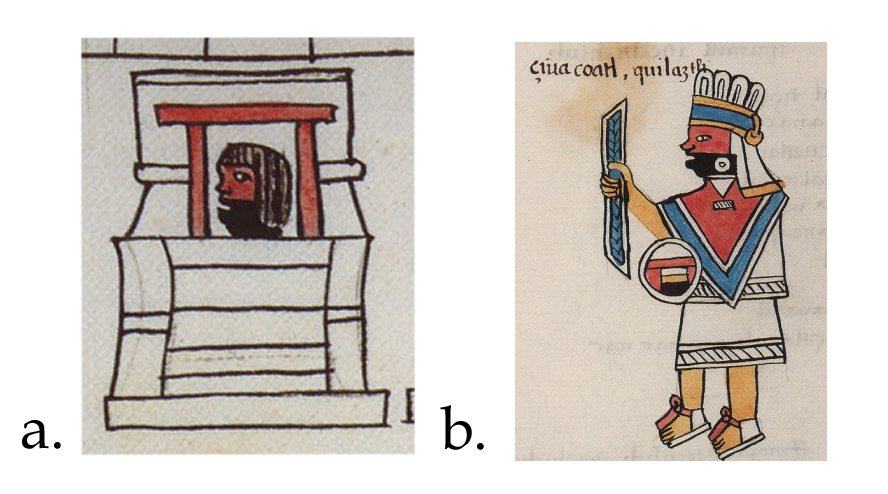
Figure 4. The Colhuacan Teocalli, or temple of Cihuacoatl in the Primeros Memoriales 269r.

Before proceeding to propose this small correction for Seler’s diagram, it is necessary to address the question of whether this pictography actually depicts Tepepolco rather than Tenochtitlan or an idealized version of it. In her article on the illustrations of each of the veintenas in the Primeros Memoriales, Katarzyna Granicka (2015) concluded that they could not possibly depict the provincial life of Tepepolco in account of their complexity and their lack of accordance with the glosses (2015: 224). Instead, she believes that they closely follow the celebrations at Tenochtitlan as described in the Florentine Codex and in Durán, “an important argument in favour of the hypothesis that they (the images at the Primeros Memoriales) derive from Tenochtitlan” (2015: 225). This can also be inferred from the text constantly referring to the political life of the capital, as it is the case with the chapter on rulership, which in its Chapter III deals with the general notions of the Tenochca empire rather than with the provintial life of Tepepolco. This means that, probably, the originals drawn at Tepepolco, which are lost, were re-drawn and glossed by the Tlatelolca in their own way. But the problem remains: if the Primeros Memoriales depict life in Tenochtitlan rather than in Tepepolco, what to make of this diagram, which conflicts in many points with archaeology? [1] The only solution is that which Granicka proposes, namely, that the original testimonies and pictographies gathered at Tepepolco referred to Tenochtitlan but only in an approximate fashion, being prone to mistakes and errors.

            In any case, here I present my own proposal, which differs from Seler in two points only. As for the location of the cuauhxicalli or ‘vase of the eagles’, which is not apparent in the diagram, I would agree with him that in the diagram it is confused with the ixmomoztli or ‘frontal altar’. This can be sustained with the fact that all sources agree that the cuauhxicalli was in front of the Huey Teocalli and next to the temalacatl, which in turn was in front of the Yopico Teocalli, and which were part of a courtyard dedicated to war deities (Xipe and Tonatiuh, the sun). Finally, the odd location of the Cuauhcalli in the diagram, which is to the east or behind the Huey Teocalli, rather than to the north or right next to it (as it really was), could be explained by the relative lack of familiarity of the Tepepolcan tlacuilos with Tenochtitlan, as well as the fact that the actual place of the cuauhcalli is occupied in the pictography by the oversized statue of the god Macuilcuetzpalin. Of course, however, the other two possibilities mentioned above, namely, that the diagram is either of Tepepolco or an idealized illustration, are not to be discarded: however, this proposal doesn’t conflict with either. In any case, here would be the corrected scheme (Figure 5).
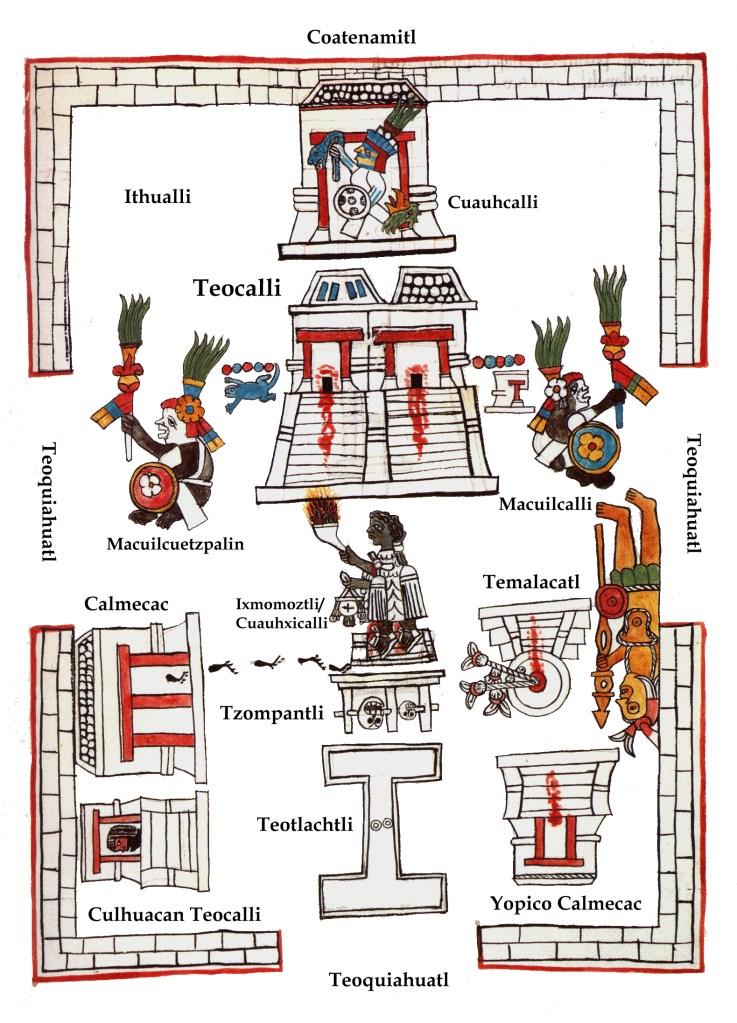
Figure 5. Cececni teocalco, ‘The many houses of the gods’, as depicted in the Sahagun’s Primeros Memoriales, 269r.

  1. Teocalli: ‘Temple’, a pyramid with two joined temples at its top, those of Huitzilopochtli and Tlaloc, also known as huey teocalli.
  2. Cuauhxicalli: ‘Vase of the Eagle’, a circular, sacrificial stone vessel depicted nowhere in the diagram, but which rested atop a momoztli or platform-altar next to the Temalacatl and in front of the huey teocalli.
  3. Calmecac: A priestly school. We can see the steps of a priest which exists from it and censes the cuauhxicalli atop the ixmomoztli or ‘frontal altar’.
  4. Ixmomoztli: ‘Front altar’, placed right before the great temple. Atop it lied the cuauhxicalli or vase of the eagle, a sacrificial vessel.
  5. Cuauhcalli: ‘House of the eagles’, a temple associated with war, denoted by the glyph of an eagles’ head, with an image of Huitzilopochtli, god of warriors. The word could also denote the war council inside the palace of Moctezuma, and any kind of barracks or war-huts. In real life it stood next to the huey teocalli.
  6. Teotlachtli: A ball court dedicated to the gods.
  7. Tzompantli: ‘Skull banner’, a rack with skulls impaled across wooden beams. Now, thanks to archaeology, we know that its edges were placed circular ‘towers’ of skulls.
  8. Yopico Teocalli: The temple of Xipe Totec, ‘our lord the flayed one’, god of goldsmiths, vegetation, and warriors.
  9. Temalacatl: A circular stone to be used in the combat between captives and warriors at Tlacaxipehualiztli, ‘flaying of men’, one of the rituals of the 18 months in the Aztec year solar year or Xihuitl.
  10. Colhuacan Teocalli: A temple dedicated to Cihuacoatl, warrior goddess of Colhuacan, considered, among other goddesses, as “mother of the gods”.
  11. Macuilcalli: ‘Five House’, a calendrical name, the temple of a Macuiltonaleque-like deity, where the execution of spies took place.
  12. Macuilcuetzpalin: ‘Five Lizard’, a calendrical name, the temple of a Macuiltonaleque-like deity associated with pleasure and excess. Of unknown function, although, given that other temples dedicated to the Macuiltonaleque were associated with the execution of captives, it could have had a similar purpose.
  13. Ithualli: ‘Courtyard’, the patio itself. In the Florentine Codex (II: 179), the informants call the whole of the sacred precinct in ithual catca Huitzilopochtli, ‘The courtyard where Huitzilopochtli was”. It is possible that the term, ‘courtyard of the god’, was a synonym for these precincts as a whole, rather than just of the dancing plazas in them (cfr. Wood 2020, entry ‘Teuitoalco’).
  14. Coatenamitl: ‘Wall of snakes’, the surrounding wall of the precinct, perhaps decorated with snakes. Not to be confused with the Coatepantli, an enclosure of snakes around the huey teocalli itself.
  15. Teoquiahuatl: ‘Sacred portals’; as the Primeros Memoriales explain, there were three of them, on all sides except on the rear of the great temple.

Acknowledgements

I want to thank Stan Declerc and Gabriel Kruell for their commentaries and suggestions while reading this entry; all the faults in this text are mine alone.

References

Couvreur, Aurélie. 2002. “La description du Grand Temple de Mexico par Bernardino de Sahagún (Codex de Florence, annexe du Livre II).” Journal de la Société des américanistes 88: 9-46.

Durán, Diego. 2002. Historia de las Indias de Nueva España e Islas de Tierra Firme. México: CONACULTA.

González Torres, Yolotl. 1985. El sacrificio humano entre los Mexicas. Mexico: INAH/FCE.

León-Portilla, Miguel. 1987a. ‘The Ethnohistorical Record for the Huey Teocalli of Tenochtitlan.’ In E. H. Boone, ed. The Aztec Templo Mayor, 71-95. Washington DC: Dumbarton Oaks Research Library and Collection.

Granicka, Katarzyna. 2016. “En torno al origen de las imágenes de la sección de las veintenas en los Primeros Memoriales de fray Bernardino de Sahagún.” Revista Española De Antropología Americana 45 (1), 211-227.

López Austin, Alfredo. 2009. Monte Sagrado-Templo Mayor. El cerro y la pirámide en la tradición religiosa mesoamericana. Mexico: INAH, UNAM/IIA.

López Luján, Leonardo, and Raúl Barrera. 2011. “Hallazgo de un edificio circular al pie del Templo
Mayor de Tenochtitlan.” Arqueología Mexicana 112: 17.

Marquina, Ignacio. 1960. El Templo Mayor de México, INAH, Mexico.

Matos Moctezuma, Eduardo. 1999. “Sahagún y el recinto ceremonial de Tenochtitlan”, Arqueología Mexicana 6 (36): 22-31.

Mazzetto, Elena. 2014. Lieux de culte et parcours cérémoniels dans les fêtes des vingtaines à Mexico – Tenochtitlan. Oxford: Archaeopress.

Orduña, Santiago. 2008. Coatepec: The Great Temple of the Aztecs. Recreating a Metaphorical State of Dwelling. PhD Thesis, School of Architecture. McGill University.

Sahagún, Bernardino de. 1997. Primeros Memoriales, T. D. Sullivan (trad.), University of Oklahoma Press, Norman.

Sahagún, Bernardino de. 1981. Florentine Codex: General History of the Things of New Spain. Book 2: The Ceremonies. Trans. C. E. Dibble and J. O. Anderson. Santa Fe, NM: The School of American Research.

Seler, Eduard. 1904. “Die Ausgraben am Orte des Haupttempels in México”. In Gesammelte Abhandlungen zur Amerikanischen Sprach- und Alterthumskunde. Second volume, 767-912. Berlin: Asher & Co.

Townsend Richard, F. 1987. “Coronation at Tenochtitlan.” In The Aztec Templo Mayor, ed. E. H. Boone, 371-409. Dumbarton Oaks Research Library and Collection, Washington D.C.


[1] For example, by locating the cuauhcalli either behind the Huey Teocalli, or in front of it.

La lectura del glifo de atemoztli

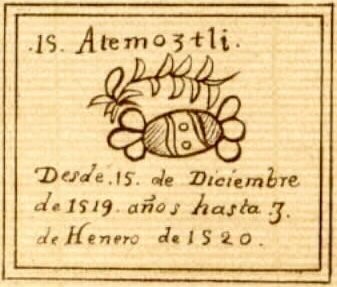
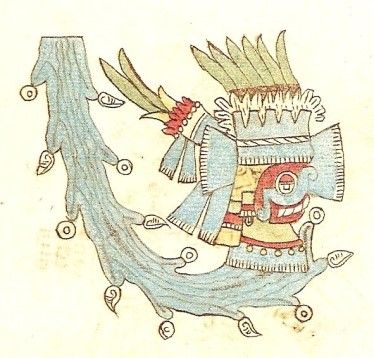
En relación a los glifos y a las escenas pictográficas que aparecen en los códices y manuscritos coloniales y que se refieren a la fiesta de atemoztli,[1] podemos hacer las siguientes observaciones.[2] Los glifos que aparecen en gran parte de las fuentes presentan generalmente la figuración pictográfica de una corriente de agua que baja o gotas de lluvia que caen. Estos elementos acuáticos se pueden leer en náhuatl como a-temo (agua que baja).

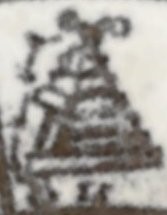
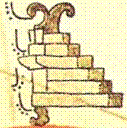
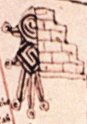
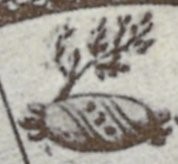
En las fuentes en las cuales aparece solamente el glifo de atemoztli, sin asociación con ningún otro elemento pictográfico, el agua baja o surge de una base piramidal o altar, que veremos podría leerse en náhuatl como complemento fonético *moz.[3] Los documentos en los cuales aparece esta estructura arquitectónica son el Códice Vaticano A (figura 1), las Ruedas Boturini No. 4 (figura 2) y Veitia No. 4 (figura 3), Muñoz Camargo (figura 4) y la Rueda Veitia No. 5 (figura 5). A veces, además del chorro de agua y del altar se muestra una fila de huellas de pies descendientes (figuras 1, 2 y 3), elemento fonético que indica el verbo “bajar” (temo). En el caso de la Rueda Boban (figura 6), no aparece el basamento piramidal escalonado y en su lugar está la imagen de una piedra (tetl), que funge como complemento fonético te que complementa la expresión a-temo (agua que baja). En otros dos casos, Serna y la Rueda Boturini No. 5 (figuras 7 y 8), tenemos únicamente el elemento fonético de la piedra (te) acompañado de lo que parece ser una rama, que normalmente se lee xiuh, “hoja” o “hierba” en náhuatl. Este elemento vegetal no tiene sentido para la lectura de atemoztli y existe la posibilidad de que autores tardíos como Serna, en el siglo XVII, y Boturini, en el XVIII, quien probablemente copió a Serna, confundieron el elemento fonético del flujo de agua (a) con las hojas de una planta o la fronda de un árbol (xiuh).

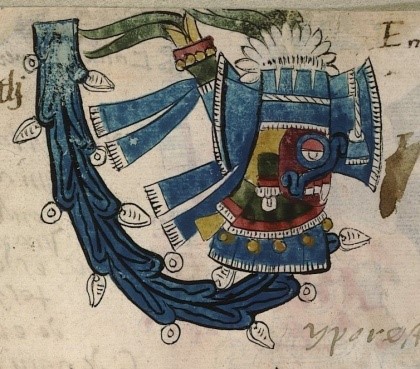
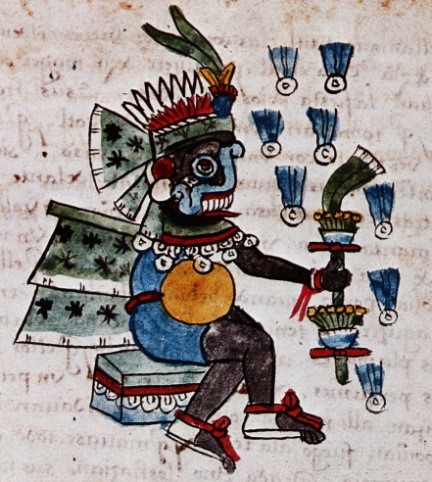
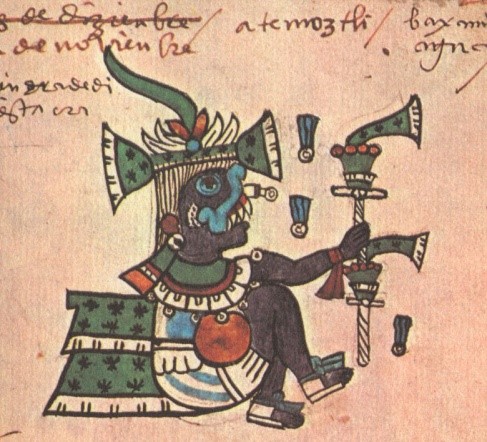
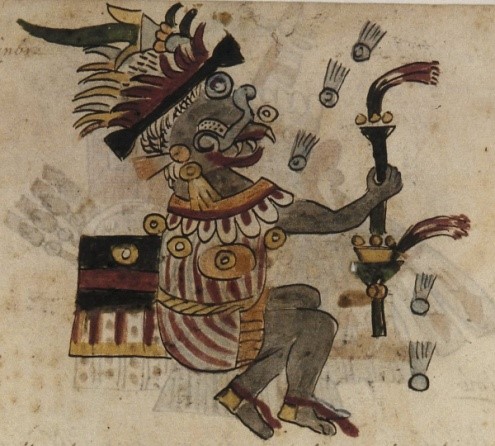
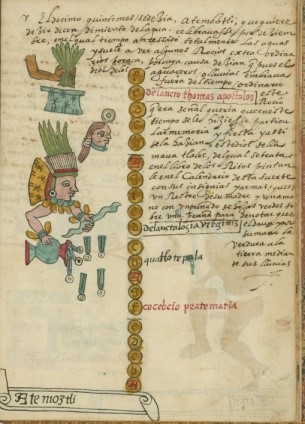
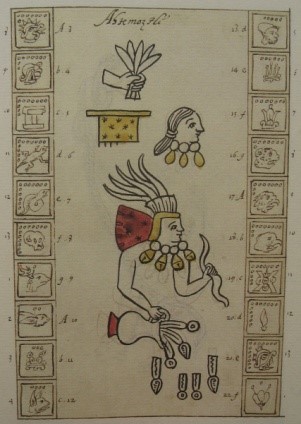
Otras fuentes iconográficas asocian el glifo de atemoztli a elementos pictográficos más o menos complejos. En los Códices Telleriano-Remensis (figura 9) y Vaticano A (figura 10), el glifo compuesto por una corriente de agua descendiente se combina con la cabeza del dios Tláloc, mientras que en los Códices Magliabechiano (figura 11), Tudela (figura 12), Ixtlilxóchitl (figura 13) y Veitia (figura 14) aparecen gotas de lluvia que se asocian al cuerpo completo de este mismo dios. Volvemos a encontrar el glifo de las gotas de lluvia en otras imágenes complejas, como los Códices Matritenses de Sahagún (figura 15)[4] y el Códice Tovar (figura 16) y el Calendario Mexicano (figura 17). En estas dos últimas fuentes, un personaje ataviado como Tláloc, sacerdote o representante humano (teixiptla) vierte agua por medio de un cántaro.

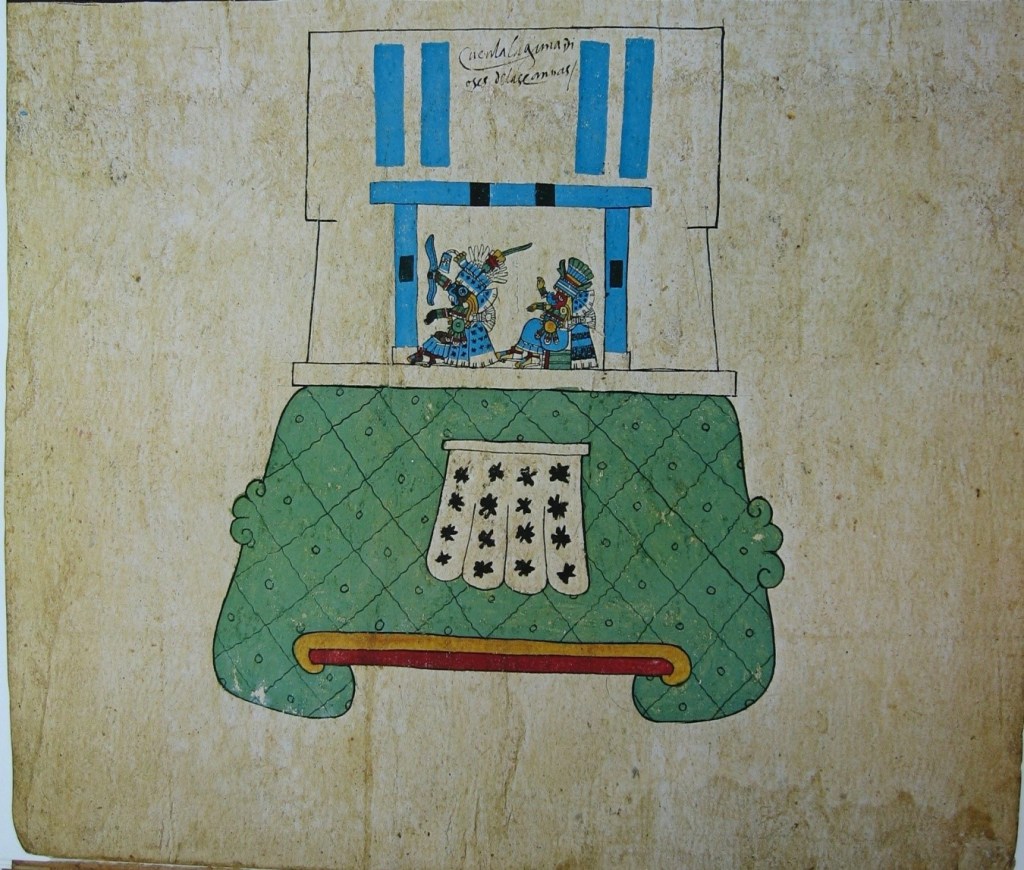
En fin, no podemos dejar de mencionar al único códice de probable origen prehispánico, el Códice Borbónico, que representa una escena compleja de la fiesta de atemoztli (figura 18), pero no reporta ningún glifo pictográfico alusivo al nombre de la festividad. En la lámina 35 del Borbónico, vemos un enorme cerro vestido con un atavío de papel manchado de hule (amatetehuitl), en cuya cumbre se encuentra un adoratorio acuático (ayauhcalli) presidido por las figuras de Tláloc y su consorte Chalchiuhtlicue. En la techumbre del templo, un comentarista español escribió la siguiente glosa: “Cu en la laguna, dioses de las canoas”.

La ausencia del glifo de atemoztli en el Borbónico es para mí muy significativa y me impulsa a pensar en la posibilidad de que los tlacuiloque de este códice no tenían la necesidad de indicar pictográficamente que se trataba de la veintena de atemoztli, porque esto resultaba obvio para un lector nativo, que ubicaba inmediatamente el nombre de la fiesta por las figuraciones del cerro, del templo y de los dioses acuáticos y por su contexto en el ciclo anual de las veintenas, después de la fiesta del Fuego Nuevo-panquetzaliztli y antes de la veintena de tititl (Códice Borbónico, láminas 34 y 36). Aunque se ha querido argumentar que el Borbónico es un códice de origen colonial, por algunos elementos influenciado por el dibujo europeo y por las escuetas glosas españolas que recibió, en esta lámina 35 del amoxtli nada parece sugerir una influencia europea. El laconismo y la imprecisión de la glosa española “Cu en la laguna, dioses de las canoas”, contrasta con los abundantes comentarios que podemos leer normalmente en los códices coloniales, llevándonos a pensar que pasó bastante tiempo entre el momento de la confección del manuscrito – probablemente en la época prehispánica – y el momento en el que fue glosado. Es posible inclusive que el comentarista del Borbónico desconociera el nombre náhuatl de la fiesta de atemoztli.

Nos queda solamente comentar la extraña imagen que aparece en el Manuscrito Durán (figura 19). En la parte superior de la ilustración de la fiesta de atemoztli que se puede ver en la obra de Durán (Historia de las Indias de Nueva España, f. 342r) vemos a un personaje de cabeza vestido con una túnica al estilo griego o romano que baja de un cielo estrellado. Del glifo pictográfico de atemoztli queda únicamente la acción de “bajar”, sin embargo no parece haber ninguna referencia al elemento “agua”. El mismo Durán explica la imagen que ilustra su obra de esta manera: “Era la figura de este día la que vemos pintada en el principio de este mes, fingían que bajaba un niño del cielo este día y a este niño llamaban Agua como del vocablo mexicano se colige, conviene a saber, atemoztli que quiere decir el “bajamiento de agua”, atl quiere decir “agua”, temo quiere decir “bajar”, y así componen atemoztli, que quiere decir lo dicho”.[5] De acuerdo a Durán entonces, el personaje que baja del cielo sería un niño, personificación del agua. Es evidente que el tlacuilo del Manuscrito Durán no disponía de una referente prehispánico del glifo de atemoztli y optó por copiar un imagen renascentista de ispiración clásica.

Regresando al análisis de los glifos de atemoztli, podemos darnos cuenta que éstos podían aparecer en las fuentes coloniales solos (indicando un período de tiempo del cempohuallapohualli o calendario de las veintenas) o podían presentarse en asociación con diversos elementos rituales: dioses (en el caso de atemoztli Tláloc o Chalchiuhtlicue), personajes (sacerdotes, personificaciones de los dioses, etc.), lugares (cerros, templos, etc.), objetos (instrumentos, atavíos, etc.) y acciones (el bajar o verter agua, el ofrendar comida o bebida, etc.). Los glifos de atemoztli podían además variar bastante, dependiendo del período histórico, la tradición escrituraria y la región de origen. Aunque todos los glifos presentan por lo menos dos elementos de base – el chorro de agua que desciende o las gotas de lluvia que caen, cuya lectura es a-temo (agua que baja) – en algunas partes se podían utilizar ciertos refuerzos fonéticos particulares, como las huellas de pie que bajan (temo), la piedra (te), o el basamento piramidal, del cual proponemos la lectura tentativa *moz.

Esta posible lectura implicaría que las estructuras piramidales que aparecen en los glifos de atemoztli del Códice Vaticano A, de las Ruedas Boturini No. 4 y Veitia No. 4, de Muñoz Camargo y de la Rueda Veitia No. 5, podrían quizás leerse como momoztli, palabra que en náhuatl significa “altar” o “adoratorio”. En este caso particular, la palabra momoztli sólo se leerían la segunda sílaba *moz, eliminando la primera sílaba mo. Casos parecidos a éste serían aquéllos de la lectura del glifo de Aztlan en el Códice Boturini, propuesta recientemente por Alonso Zamora en este blog, donde del glifo de la caña-popote (piaztli) se leería solamente su segunda sílaba *az, eliminando la primera sílaba pi, y el ejemplo señalado por Gordon Whittaker (2009: 63), en el cual del glifo de huipil (huipilli) en el topónimo de Chipiltépec sólo se leería la segunda sílaba *.pil, eliminando la primera sílaba hui.[6]

La lectura del elemento piramidal del glifo de atemoztli como sílaba *moz es sugerida por Jacinto de la Serna en su obra Manual de ministros de indios: “El décimo quinto mes se llamaba atemoztli, que quiere decir “ara de los dioses del agua”, como síncopa de ateomomoztli“.[7] Evidentemente Serna estaba equivocado sobre el significado de la palabra atemoztli, que como señaló Durán significa “bajamiento de agua” y no “altar de los dioses del agua”, sin embargo, es posible que Serna conociera el glifo de atemoztli en el cual aparece la figura de un altar o basamento piramidal y que él mismo dedujera, o algún intérprete náhuatl le sugiriera, la lectura momoztli, llevándolo a constituir la falsa etimología “altar de los dioses del agua”. El fenómeno de la “síncopa” aludido por Serna podría referirse entonces no tanto al significado de atemoztli, sino a su lectura pictográfica, en la cual se tendría que sincopar, es decir eliminar, la primera sílaba mo, quedando únicamente la segunda *moz.[8]

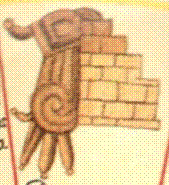
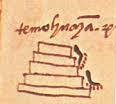
Termino esta brevísima nota sobre la lectura de los glifos de atemoztli, mostrando un contraejemplo que pone en tela de juicio la lectura de la sílaba *moz aquí propuesta. En el folio 27r del Códice Mendoza (figura 20), encontramos el glifo de Temohuayan, un pueblo tributario de la Triple Alianza. Como en algunos de los glifos de atemoztli, observamos las huellas de pie que bajan de una plataforma piramidal, elemento logográfico que nos da la lectura del verbo temo (bajar). En este caso, es evidente que el elemento arquitectónico escalonado es solamente una apoyo pictográfico que ayuda a leer las huellas de pie como la acción de “descender” o “bajar”, sin ninguna lectura fonética en sí mismo. ¿Deberíamos entonces desechar las posible lectura *moz para la estructura escalonada que vemos en los glifos de atemoztli? Sólo un tlacuilo prehispánico nos sacaría de la duda. Mientras tanto, someto esta posible lectura al criterio y a los comentarios de los lectores y especialistas interesados en este blog.

Figura 1

Códice Vaticano A, f. 87r: glifo de atemoztli con chorro de agua que baja (a-temo), elemento piramidal (posible lectura *moz) y huellas descendientes (temo).

Figura 2

Rueda Boturini No. 4 (muy borroso por la baja resolución): glifo de atemoztli con chorro de agua (a), elemento piramidal (posible lectura *moz) y huellas descendientes (temo).

Figura 3

Rueda Veitia No. 4 (probable copia de la Rueda Boturini No. 4): glifo de atemoztli con chorro de agua (a), elemento piramidal (posible lectura *moz) y huellas descendientes (temo).

Figura 4

Muñoz Camargo, Descripción de la ciudad y provincia de Tlaxcala (rueda calendárica dibujada entre los f. 176 y 178): glifo de atemoztli con chorro de agua que baja (a-temo) y elemento piramidal (posible lectura *moz).

Figura 5

Rueda Veitia No. 5 (probable copia de Muñoz Camargo): glifo de atemoztli con chorro de agua que baja (a-temo) y elemento piramidal (posible lectura *moz).

Figura 6

Rueda Boban: glifo de atemoztli con doble chorro de agua que baja (a-temo), una piedra (te) y huellas descendientes (temo).

Figura 7

Serna, Manual de ministros de indios (tabla calendárica dibujada final de la obra): glifo de atemoztli con el elemento fonético de la piedra (te) y una rama (probable lectura xiuh).

Figura 8

Rueda Boturini No. 5 (probable copia de Serna): glifo de atemoztli con el elemento fonético de la piedra (te) y una rama (probable lectura xiuh).

Figura 9

Códice Telleriano-Remensis, f. 5v: glifo de atemoztli con un chorro de agua descendiente (a-temo) asociado a la cabeza de Tláloc.

Figura 10

Códice Vaticano A, f. 45r (probable copia del Códice Telleriano-Remensis): glifo de atemoztli con un chorro de agua descendiente (a-temo) asociado a la cabeza de Tláloc.

Figura 11

Códice Magliabechiano, f. 44r: glifo de atemoztli con gotas de agua que caen (a-temo) asociado a un Tláloc de cuerpo completo.

Figura 12

Códice Tudela, f. 26r (probable copia del Códice Magliabechiano): glifo de atemoztli con gotas de agua que caen (a-temo) asociado a un Tláloc de cuerpo completo.

Figura 13

Códice Ixtlilxóchitl, f. 101v (probable copia del Códice Magliebechiano o Tudela): glifo de atemoztli con gotas de agua que caen (a-temo)asociado a un Tláloc de cuerpo completo.

Figura 14

Códice Veitia, f. 16r (probable copia del Códice Ixtlilxóchitl): glifo de atemoztli con gotas de agua que caen (a-temo)asociado a un Tláloc de cuerpo completo.

Figura 15

Fray Bernardino de Sahagún, Códices Matritenses, f. 252v: en la esquina superior derecha, glifo de atemoztli con gotas de agua (a-temo) asociado a una escena de ofrenda de pulque.

Figura 16

Códice Tovar, f. 155r: glifo de atemoztli con gotas de agua que caen (a-temo) asociado a un sacerdote o representante humano (teixiptla) de Tláloc que vierte agua de un cántaro.

Figura 17

Calendario Mexicano, f. 98r (probable copia del Códice Tovar): glifo de atemoztli con gotas de agua que caen (a-temo) asociado a un sacerdote o representante humano de Tláloc que vierte agua de un cántaro.

Figura 18

Códice Borbónico, lámina 35: escena correspondiente a la fiesta de atemoztli, en la cual no aparece ningún glifo de atemoztli.

Figura 19

Manuscrito Durán, f. 342r: Escena de atemoztli con glifo extraño (personaje que baja de un cielo estrellado), probablemente de inspiración europea.

Figura 20

Códice Mendoza, f. 27r: Glifo de Temohuayan con huellas de pie descendientes de un basamento piramidal (lectura temo), en el cual la estructura arquitectónica en sí no tiene ningún valor fonético.

Reproducciones digitales de los códices consultables en línea

Códice Borbónico: http://www.assemblee-nationale.fr/histoire/7gf-borbonicus.asp.

Códice Ixtlilxóchitl: http://gallica.bnf.fr/ark:/12148/btv1b84701752.

Códice Mendoza: https://iiif.bodleian.ox.ac.uk/iiif/viewer/2fea788e-2aa2-4f08-b6d9-648c00486220.

Códice Telleriano-Remensis: http://gallica.bnf.fr/ark:/12148/btv1b8458267s.

Códice Tovar: www.wdl.org/en/item/6759/#q=tovar&qla=en.

Códice Vaticano A: https://digi.vatlib.it/view/MSS_Vat.lat.3738.

Rueda Boban: https://commons.wikimedia.org/wiki/File:The_Boban_Aztec_Calendar_Wheel_WDL6760.png.

Códices Matritenses de fray Bernardino de Sahagún: http://bdmx.mx/documento/galeria/bernardino-sahagun-codices-matritenses.

Reproducciones facsimilares de los códices

Calendario Mexicano, en el manuscrito Cantares Mexicanos, edición facsimilar, México, Universidad Nacional Autónoma de México, Instituto de Investigaciones Bibliográficas, 1994, f. 85-100.

Códice Magliabechiano, en Ferdinand Anders (ed.), Códice Magliabechiano. Cl. XIII. 3 (B.R. 232), Biblioteca Nazionale Centrale di Firenze, Graz, Akademische Druck-und Verlagsanstalt, 1970.

__________, en Ferdinand Anders, Maarten Jansen, Luis Reyes García (comisión técnica investigadora) Libro de la vida. Texto explicativo del llamado Códice Magliabechiano, CL.XIII.3 (B.R.232), Biblioteca Nacional de Florencia, introducción y explicación de Ferdinand Anders y Maarten Jansen, con contribuciones de Jessica Davilar y Anuschka Van’t Hooft, Austria-México, Akademische Druck-und Verlagsanstalt-Fondo de Cultura Económica, 1996.

Códice Tudela, en Juan José Batalla Rosado (ed.), El Códice Tudela y el Grupo Magliabechiano. La tradición medieval europea de copia de códices de América, original conservado en el Museo de América de Madrid, 2 v., presentación de José Luis de Rojas, director del Departamento de Historia de América II, estudio de Juan José Batalla Rosado, profesor de la Universidad Complutense de Madrid, Madrid, Ministerio de Educación, Cultura y Deporte-Agencia Española de Cooperación Internacional-Testimonio, 2002.

Códice Veitia, enJosé Alcina Franch (ed.), Códice Veitia. Modos que tenían los indios para celebrar sus fiestas en tiempos de la gentilidad, edición facsimilar, estudio, trascripción y notas de José Alcina Franch, presentación de Francisco Morales Padrón, Madrid, Testimonio, 1986.

Muñoz Camargo, Diego, Descripción de la ciudad y provincia de Tlaxcala de las Indias y del Mar Océano para el buen gobierno y ennoblecimiento dellas, edición facsimilar del manuscrito de Glasgow con un estudio preliminar de René Acuña, México, Universidad Nacional Autónoma de México, Instituto de Investigaciones Filológicas, 1981.

__________, Descripción de la ciudad y provincia de Tlaxcala, en René Acuña (ed.), Relaciones geográficas del siglo XVI. Tlaxcala, 2 v., México, Universidad Nacional Autónoma de México, Instituto de Investigaciones Antropológicas, 1984.

Ruedas Boturini Nos. 4 y 5, en Lorenzo Boturini Benaduci, Historia general de la América Septentrional, edición, estudio, notas y apéndice documental de Manuel Ballesteros Gaibrois, México, Universidad Nacional Autónoma de México, Instituto de Investigaciones Históricas, 1990.

Ruedas Veitia Nos. 4 y 5, en Mariano Veitia, Los calendarios mexicanos, edición facsimilar, dirección editorial de Miguel Ángel Porrúa y Luz María Bueno de Porrúa, México, Miguel Ángel Porrúa, 1994.

Serna, Jacinto de la, Manual de ministros de indios para el conocimiento de sus idolatrías, y extirpación de ellas, México, Imprenta del Museo Nacional, 1892.


[1] Agradezco al Dr. Marc Thouvenot, investigador emérito del CNRS (Francia) por haberme facilitado las reproducciones fotográficas de los facsímiles de los manuscrtios y códices que se muestran en esta entrada. El Dr. Thouvenot reunió todas las imágenes relativas a los calendarios nahuas en un programa informático llamado Tonalpohua, el cual pronto estará disponible para el público en el sitio http://cen.sup-infor.com. Las fotos del glifo de atemoztli proporcionadas por el Dr. Thouvenot aparecen en los siguientes códices y manuscritos mexicanos: Rueda Boban; Códice Telleriano-Remensis, f. 5v; Códice Vaticano A, f. 45r; 87r; Códice Magliabechiano, f. 44r; Códice Tudela, f. 26r; Códice Ixtlilxóchitl, f. 101v; Códice Veitia, f. 16r; fray Bernardino de Sahagún, Códices Matritenses, f. 252v; Manuscrito Durán, f. ; Códice Tovar, f. 155r; Calendario Mexicano, f. 98r; Diego Muñoz Camargo, Descripción de la ciudad y provincia de Tlaxcala (rueda calendárica dibujada entre los f. 176-178); Jacinto de la Serna, Manual de ministros de indios (tabla calendárica dibujada al final de la obra); Ruedas Boturini Nos. 4 y 5; Ruedas Veitia Nos. 4 y 5.

[2] Para un tratamiento exhaustivo de los glifos de las fiestas de las veintenas nahuas, véase el artículo de Ana Díaz, “Nombrar las veintenas en los códices. Estrategias coloniales de reconfiguración gráfica del año entre los nahuas”, Anales del Instituto de Investigaciones Estéticas, v. 40, n. 113, 2018, 0. 145-195: http://www.analesiie.unam.mx/index.php/analesiie/article/view/2653/3346.

[3] El asterisco indica que sólo se trata de una lectura hipotética.

[4] Es interesante notar que en los Códices Matritenses, las gotas de lluvia están dibujadas en la dirección equivocada y, en lugar de bajar, parecen subir.

[5] Fray Diego Durán, Historia de las Indias de Nueva España e islas de tierra firme, 2. v., estudio preliminar de Rosa Camelo y José Rubén Romero, México, Consejo Nacional para la Cultura y las Artes, Dirección General de Publicaciones, 1995, v. II, p. 285.

[6] Alonso Zamora, “Return to Aztlan: A Glyph Reconsidered”, https://tlacuilolli.com/2021/03/23/7/. La lectura de Whittaker es citada por Zamora, ibidem.

[7] Jacinto de la Serna, Manual de ministros de indios para el conocimiento de sus idolatrías, y extirpación de ellas, México, Imprenta del Museo Nacional, 1892, p. 325.

[8] Agradezco a Siddharta Carrillo por haber llamado mi atención sobre este texto de Serna y sobre el glifo de atemoztli que aparece en el Códice Mendoza y que comentaré a continuación.

A bloody marquess: On Hernán Cortés’ name and title in Nahuatl writing


Abstract:
In this entry, I argue that Hernán Cortés had two glyphs denoting him in Nahuatl writing, both appearing in Codex Mexicanus: a) te, (Cort)és, Cortés, this glyph denotes his name; b) ez, (marqu)és, Marquess; this glyph denotes Cortés nobiliary title, and derives from the glyph EZ, eztli, 'blood', perhaps working in a syllabic way.

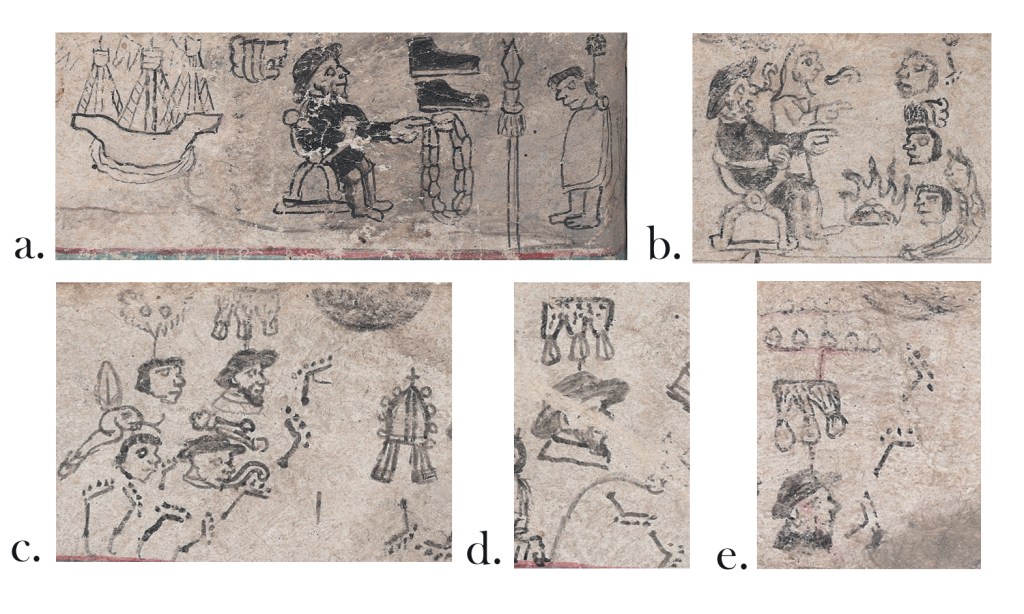
Despite his historical importance and being a familiar presence in Aztec colonial pictorials, the name of Hernán Cortés is a rare sight in Nahuatl writing. The conquistador is usually depicted with his name, or the title marqués, in alphabetic characters; iconographically, he is easy to recognize by the severe black garments that were de rigeur for any aspiring nobleman in the nascent Spanish empire, specially one of a dubious social standing, as he was. His iconography across many pictorials is quite consistent: completely black-clad, a feathered hat, and sitting on a Savonarola style Renaissance armchair (Figure 1).

Figure 1. Cortés’ iconography in Nahuatl pictorials: a) Codex Durán, meeting with the Tlillancalqui of Tenochtitlan; b) Lienzo de Tlaxcala, Texas fragment: meeting with Xicotencatl and Tlaxcalan nobility c) Florentine Codex, Book XII, another rendering of the meeting with Moctezuma’s envoys

Most Aztec colonial pictorials coincide in representing Cortés as nameless in terms of Nahuatl glyphs, not even depicting his title. The glyphic names of other Spanish conquistadors and imperials are better known, to the point of being nowadays textbook examples of Nahuatl strategies on the hieroglyphic representation of European names: Pedro Alvarado, called Tonatiuh by the Aztec, has a sun glyph as his name, read as TONA, Tona(tiuh), in Codex Telleriano Remensis 46r; another famous example is vicerroy Mendoza, rendered as me-TOZA, Me(n)doza. Similarly, Spanish titles are rather common in colonial Aztec writing: vicerroy, ix-e-EL, probably ix-le-e, (v)is(o)rrey; doctor, to-TOL, dotor; executor or factor: e-pa-TOL, e(l) fa(c)tor (cfr. Valle 2006). But what about Cortés, and his title, Marquess of the Valley of Oaxaca? Recently, a new edition of Codex Mexicanus, by María Castañeda de la Paz and Michel Oudijk (2019), has appeared. This late-style document still keeps many secrets for those passionate about Aztec writing. Among its oddities, this document clearly depicts Cortés with a name glyph in many, although not all, of his appearances: his meeting at San Juan de Ulúa (actually San Juan de Culhua, as Robert Barlow remarked, 1990: 218) with the Tlillancalqui, one of the great constables of Tenochtitlan, his travel to Spain in 1527 and his return in 1530, and his final departure from New Spain in 1540, never to return (Figure 2).

Figure 2. Cortés in Codex Mexicanus: a) Cortés meets with the Tlillancalqui, page 76; b) Cortés, nameless, meets the Aztec captains: Cuauhtemoc, Motelchiuhtzin and the Cihuacoatl, page 77; c) Cortés departs to Spain alongside Nezahualtecolotzin, Coatlhuitzilihuitl, and an still undeciphered Spanish companion, page 78; d) Cortés returns to Mexico, page 78; e) Cortés departs to Spain, never to return, page 80.

Let’s concentrate on the couple of glyphs that denotes Cortés, which are not without their particular problems; first, that which denotes his fated meeting with Moctezuma’s envoys (Figure 3). Mengin suggested it was the nameplace of Tecpan Tlayacac (1952: 463), but it doesn’t resembles the appearance of this toponym in Tepetlaoztoc 4b, and we know the meeting was instead in San Juan de Ulúa; Boornazian Diel suggests a resemblance to the glyph of Tecamachalco in Codex Mendoza 42r, and a phonetical assimilation from CAMA-te to Cortés (2018: 141). Finally, Castañeda de la Paz and Oudijk considered that the name is indeed Cortés’ name, rather than a toponym, but offer no solution to its reading. It seems that the solution is perhaps anticlicmatic; the name probably reads: te, (Cor)te(s), Cortés, presenting the tentli+tetl variant of the syllabogram te. Regarding the first possibility, this kind of extreme abbreviation was not unknown in Nahuatl writing: another amusing example is that of Cepatzac, abbreviated to ce in the Matricula de Huexotzinco 387_838v. Before moving on, another thing must be added on the envoy of Moctezuma depicted here. It has been suspected that this glyph denotes the envoy that Bernal and Cortés called Tendile (sic), or Tentlil in Nahuatl according to Sahagún (Castañeda de la Paz and Oudijk 2019: 171), but given the gloss in the Durán Codex that calls the same character Tlillancalqui (see Figure 1), I consider it more probably that the tlilli, ‘black ink, soot’ glyph denotes the title rather than the name.

Figure 3. Cortés, probably rendered as te, (Cor)té(s), meets with the Tlillancalqui of Tenochtitlan, rendered as TLIL, Tlil(lancalqui). Codex Mexicanus 76.

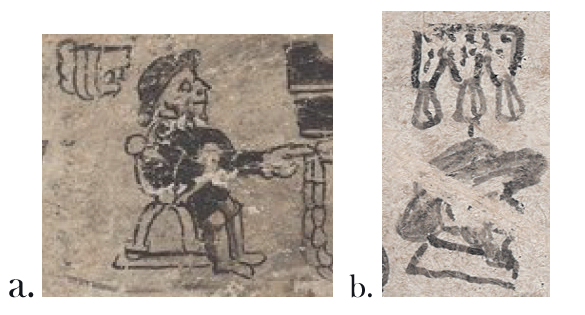
More complicated, in both an iconographic and epigraphic perspective, is the couple of scenes depicted at page 78. Commentators on the Mexicanus have long known that these scenes depict Cortés’ travel to Spain in 1528 alongside Aztec noblemen and lords, and his return in 1530 (cfr. Mengin 1952: 471-474; Castañeda de la Paz and Oudijk 2019: 177; Diel 2018: 148). Cortés has here another name sign that denotes him: dubbed trois gouttes d’eau qui tombent by Mengin (1952: 473) and ‘rain’ by Diel (2018: 147), the sign is rather close iconographically to the glyph QUIYAUH, quiyauh, ‘rainstorm’. A reading for glyph has been elusive. Mengin was doubtful between attributing it to Cortés or considering it a ‘viceregal’ glyph of sorts (1952: 473). Diel proposes that, somehow, QUIYAUH could have been assimilated to the Spanish marqués, but she doesn’t offers an explanation for this assimilation, although I believe her identification to be correct (2018: 143). María Castañeda de la Paz and Michel Oudijk concede they have no possibilities in mind for its reading (2019: 177). On close examination, the answer seems to lie in an aspect of Nahuatl writing that is unevenly depicted in Codex Mexicanus: colour. Thus, while this glyph is certainly iconographically certain to QUIYAUH, it is not actually it. Instead, this glyph closely resembles that at Mendoza 65r, which appears in the spelling of the title Ezhuahuacatl, one of the great constables of the Aztec empire (Figure 4)

Figure 4. a) Cortés glyph (Codex Mexicanus 78) b) Ezhuahuacatl title (Codex Mendoza 36r)

The Ezhuahuacatl glyph is rather intriguing. It is clearly depicts a ‘blood-sign’ iconography, being a red liquid with green jade dots, for blood was a precious liquid. But what about the stripped pattern? A colleague, Gabriel Kruell, suggested me that this pattern could be an allusion to huahuana, “to scratch, scrape, to incise lines”. Hence: EZ-hua, ezhua(huacatl), Ezhuahuacatl. And Cortés? Cortés could be a case where EZ is working here perhaps in a syllabic way, as ez, deviating a bit from its standard reading. Anomalous, but given the still obscure processes by which foreign names were rendered into Aztec writing, it is not improbable. In any case, the real question is the following: is this glyph the name Cortés, or marqués, his title? Technically, it is impossible to know, but what is certain is that the ez glyph reappears associated to Hernan’s Mestizo son, Martín, in the following pages (Figure 5).

Figure 5. Martín Cortés in the Codex Mexicanus: a) Arrival alongside Jerónimo de Valderrama, page 84; b) Execution of his supporters, the Dávila brothers, and exile, page 85.

Indeed, the ez glyph reappears multiple times in the latter portions of the Mexicanus, this time associated with the events of Martin’s life. It appears at his arrival with the visitador Jerónimo de Valderrama (another epigraphic nightmare) in 1563, at the execution of the Dávila brothers, his supporters, in 1566, and at his exile in 1567. The glyph is undoubtly his, but the problem is that Martín Cortés was both a Cortés and a marquess, like his father was. However, my hunch is that Diel was right, and despite this lack of certainty, the ‘blood’ glyph ez is actually marqués, because the glyph for Cortés already appeared before, and this name glyph changes just after Cortés started styling himself after a nobility title which was specially favoured to denote him in retrospective indigenous chronicles like Codex Aubin, where nothing is said about the arrival of Cortés nor of his exploits, but rather about those of the marqués (cfr. Tena: 2017: 55ff.). In any case, this ominous ‘blood glyph’ is oddly appropriate, not only because of the amount of human suffering that Cortes’ actions and the European colonization of the Americas brought, but also because of the bloody execution of his son’s supporters, and the tragic end of his son himself, who was tortured before dying in exile in 1589.

Acknowledgements

Again, I want to thank Gabriel Kendrick Kruell for his comments on the idea of this note. All opinions presented here are mine alone.

References

Barlow, Robert. 1990. Algunas consideraciones sobre el término “Imperio Azteca”. In Obras de Robert Barlow, eds. Jesús Monjarás-Ruiz, Elena Limón, María de la Cruz Paillés. 213-220. México: INAH/UDLA

Diel, Lori Boornazian. 2018. The Codex Mexicanus: A Guide to Life in Late Sixteenth-Century New Spain. Austin, TX: University of Texas Press.

Castañeda de la Paz, María, and Michel Oudijk. 2019. El Códice Mexicanus. México: Universidad Nacional Autónoma de México.

Mengin Ernest. 1952. “Commentaire du Codex mexicanus n° 23-24 de la Bibliothèque Nationale de Paris.” Journal de la Société des Américanistes 41 (2): 387-498.

Tena, Rafael, 2017. Códice Aubin. Vol. II. Facsimile edition. Mexico: INAH.

Valle, Perla. 2006. “Glifos de cargos, títulos y oficios en códices nahuas del siglo XVI.” Desacatos 22: 109-118. 

Return to Aztlan: A glyph reconsidered

Abstract
The mysterious glyph for Aztlan is probably a case of non-initial phonetic motivation in Aztec writing, a phenomenon first noticed by Gordon Whittaker. The iconographic identification of the glyph is piaztli, 'drinking straw'. The reading proposed here for its appearance in Codex Boturini is: az, Az(tlan), Aztlan.

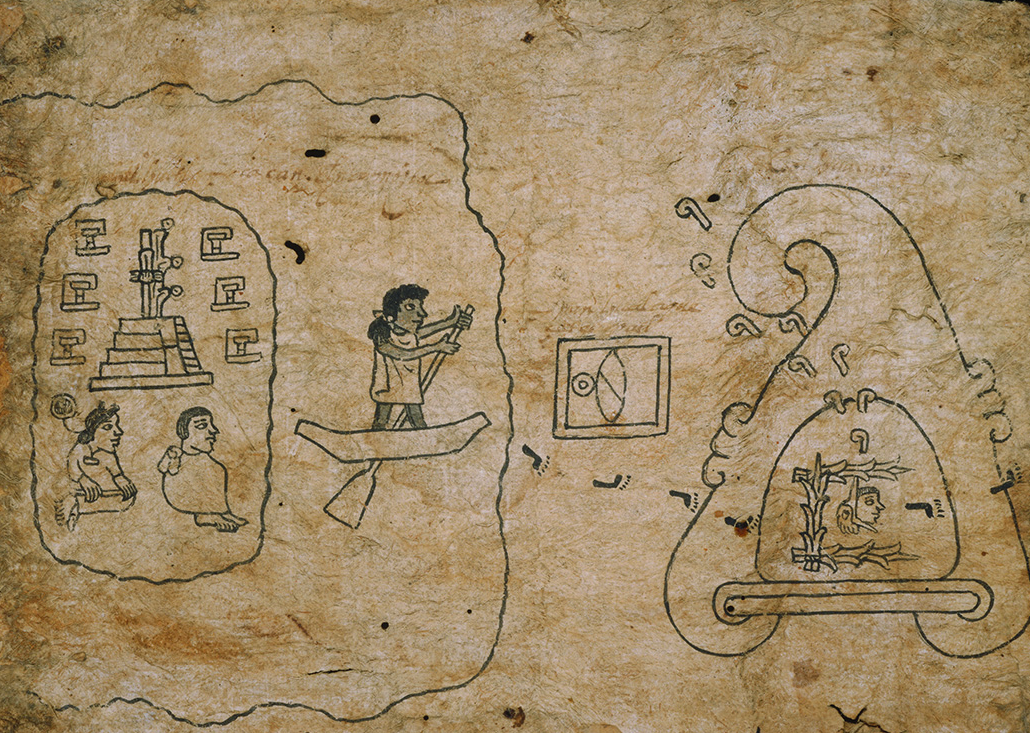
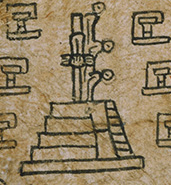
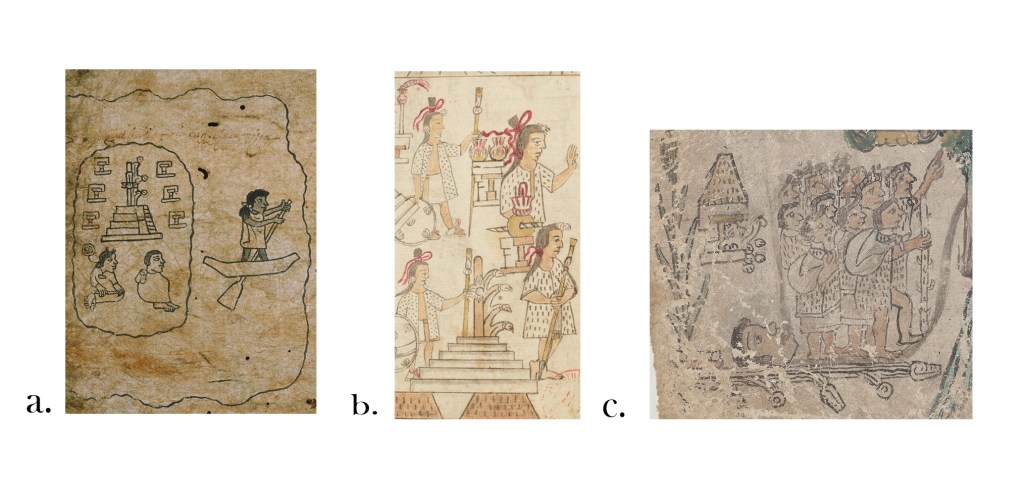
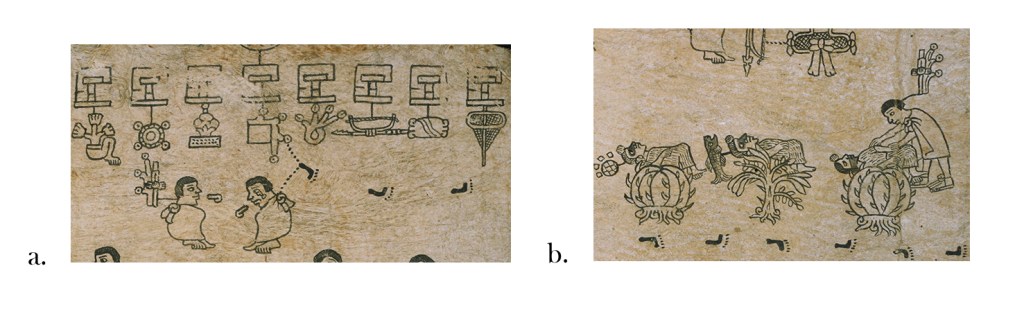
One of the most enduring enigmas in Aztec epigraphy is the reading of a glyph that figures at the very first folio of the Codex Boturini, within the famous scene that depicts the departure of the Aztec from their homeland, Aztlan (Figure 1). This glyph, standing atop a temple in the midst of the island where Aztlan was thought to be, reappears in a depiction of the same scene at Codex Azcatitlan 2r, and seems to be formed by a reed (acatl) or arrow (mitl) sign with a water (atl) sign; thus, it has been dubbed as the ‘reed-water sign’ (Herren Rajagoplan 2019: 29). A third version of this departure scene appears at Codex Mexicanus 18, where an arguably equivalent version of this glyphic compound is formed by a reed sign, a teeth (tlantli) sign, and a water sign.

Figure 1. The departure from Aztlan. a) Codex Boturini 1; b) Codex Azcatitlan 2r. c) Codex Mexicanus 18. The teeth sign, barely visible, is below the reed to the left and above the water sign.

Given the content of this scene and its parallels in Codex Aubin 3r, it has been natural to consider this glyph as the place name for Aztlan, as Eduard Seler originally proposed it (1960: 31). However, Seler’s analysis of the glyph as a water sign atl (today read as the syllabogram a) plus a depiction of a white reed or aztapilli, is problematic, given the fact that this particular rendering of a reed never reappears associated to the reading aztapilli in the extant Aztec hieroglyphic corpus. The first scholar to suggest that this glyph was not an Aztlan glyph, proposing an alternative explanation, was Robert Barlow, in his facsimile edition of the Codex Azcatitlan. According to Barlow, the glyph would better be read as the name of Amimitl, a Chichimec god of hunting and fishing (1948: 38), thus making this glyph read as a-mi, Ami(mitl), if we were to render Barlow’s reading according to current conventions (cfr. Lacadena and Kettunen 2014).

Barlow’s explanation has been recently upheld by scholars such as María Castañeda de la Paz (2007: 187), and is plausible indeed. However, the main difficulty in Barlow’s interpretation arises from the fact that the glyph reappears in folios 3 and 4, associated with a human character, rather than a god (Figure 2). When compared with alphabetic versions of these episodes, such as those present in Codex Aubin, folio 3 of Codex Boturini seems to deal with the separation of the Aztec from the rest of the calpulli that accompanied them (Huexontzica, Chalca, Xochimilca, Cuitlahuaca, Malinalca, Chichimeca, Tecpaneca and Matlatzinca), an episode which ocurred after the ominous fall of a sacred tree (cfr. Tena 2017: 37), while folio 4 seems to deal with how the Aztec ceased to use their original ethnonym after sacrificing the mimixcoa: Xiuhneltzin, Mimichtzin and his sister (cfr. Tena 2017: 37). Furthermore, the god Amimitl plays no role in the Mexica pilgrimage in any of the extant alphabetic versions; instead, Tezozomoc says that it actually was the temple of Huitzilopochtli which was located at Aztlan (2003: 53). An alternative explanation has been offered for this: the priest depicted in the Boturini is also called Amimitl, he was a prominent leader of the Aztec pilgrimage, and his name has been ommited from alphabetic renderings of this story (cfr. Castañeda de la Paz 2005: 18). Not all scholars agree with the existance of a priest called Amimitl, nor with the relevance of the god Amimitl at Aztlan; for example, the recent study on the Boturini, Aubin and Azcatitlan codices by Angela Herren Rajagoplan upholds Seler’s original reading (2019: 17). Another argument against the a-mi reading is the parallel with the Mexicanus version: there, the ‘reed-teeth-water’ glyph obviously refers to a place rather than a god, since people seem to be ‘coming out’ of a human face placed above the sign, perhaps a personified cave or mountain, making the ’emergence’ narrative more explicit.

Figure 2. The ‘water-reed’ sign associated to human characters in diferent episodes of Codex Boturini: a) The separation of the Aztec from the other tribes, folio 1; b) The sacrifice of the mimixcoa, whose names are read as XIUH, Xiuh(neltzin), and MICH, (Mi)mich(tzin); the third character is unnamed (folio 2).

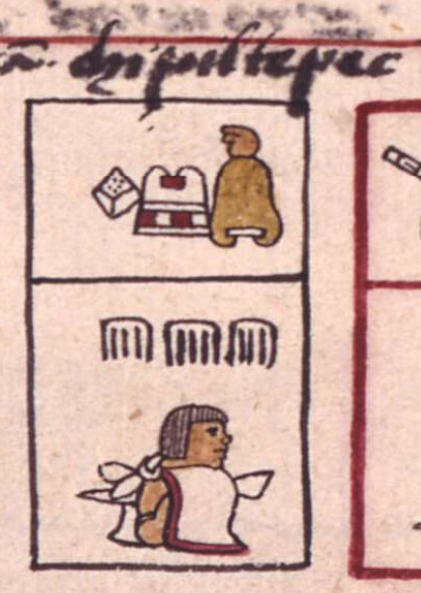
Is there a way to surmouth this difficulty? I think there is one, although it involves a proposal that is still incipient in Aztec epigraphy. In 2009, Gordon Whittaker presented a now famous analysis of an equally conflictive glyph: that of Chipiltepec, which occurs in Codex Tepetlaoztoc f. 5r (Figure 3). The curious thing about this glyph is that it is formed by the apparent sequence chi-HUIPIL-te-TEPE, but is glossed as Chipiltepec in the document. Whittaker suggested that in this case the huipilli sign is not to be read as the logogram HUIPIL, huipil, ‘blouse, shirt’, but instead as the syllabic sequence pil. Thus, the reading would be chi-pil-te-TEPE ( Whittaker 2009: 63); effectively, this reading implies omitting the first part of the huipilli sign from the reading.

Figure 3. The place name Chipiltepec, read as chi-pil-te-TEPE, Chipiltepe(c) <gloss: chipiltepec> (Codex Tepetlaoztoc f. 5r).

Whittaker’s suggestions have been subject to a strong debate and met some reservations. Mainly the problem is how to properly conceptualize this non-initial phonetic derivation in Aztec writing and, also, finding more examples to substantiate it. At a recent presentation (2021), Whittaker has proposed to call this mechanism ‘hysterophonic derivation’, or phonetic derivation from the middle/final rather than the initial part of the word; this would be (if I am not misunderstanding) more or less the opposite of the process denoted by the word acrophony. Whittaker’s book on Aztec writing is forthcoming next month, so I hope that more on this writing resource will be found there. To this nowadays famous example I could add that perhaps it is not impossible to find examples of non-initial motivation in Aztec signs. A possible instance of a similar phenomenon is the syllabogram yo (Davletshin 2013, in Lacadena and Kettunen 2014: 12), which seems to derive graphically from the coyolli (‘bell’) sign, ommiting the initial syllable from the reading.

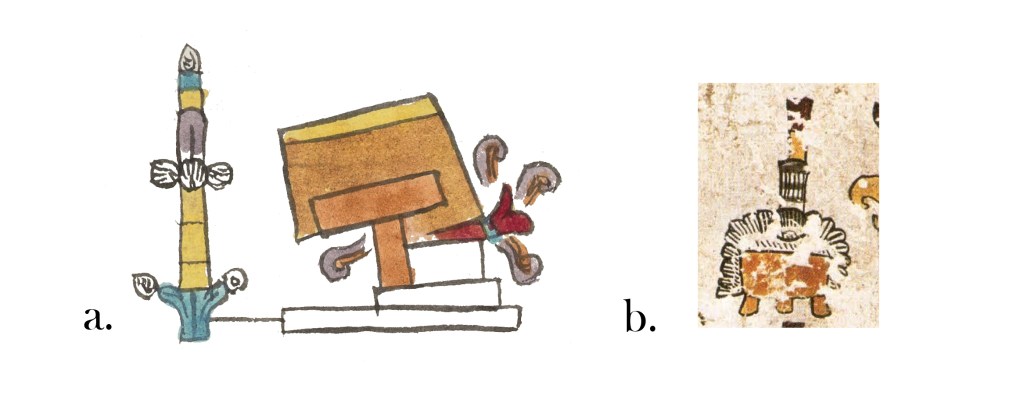
But what about Aztlan, the subject of this blog entry? What I think is that Aztlan could be yet another case of this yet not completely understood derivation mechanism. Some years ago, the philologist Patrick Johansson noticed that the ‘reed-water’ glyph at Codex Boturini was rather similar to the place glyph of Piaztlan, ‘place of long squashes’, derived from piaztli, a word which also meant a cane straw for drinking, at Codex Mendoza f. 15v, although he only offered this iconographic identification as a possibility, considering phonetic assimilation as the plausible explanation (2016: 130). I consider that Johansson’s iconographic identification is correct. Indeed, besides adding new historical characters and temples to the Aztlan story, the problem with the mi reading in this context is that sign lacks its characteristic arrowtip; when missing it, this sign is usually read as TLACOCH, ‘spear, dart’. Instead, the Aztlan glyph seems to be closer to the depiction of a drinking straw at the Mendoza, as well as other depictions of drinking straws in Mixteca-Puebla art, such as that found in Codex Borgia lam. 45, where the glyph is associated to the ritual drinking of pulque (Figure 4). These straws are depicted as dried reeds adorned with feathers, joined to water or pulque.

Figure 4. The Piaztlan sign and its iconographic motivation: a) PIAZ, Piaz(tlan), ‘Place of drinking straws’ (Codex Mendoza 15v); b) A piaztli or drinking straw atop a pulque vessel (Codex Borgia 45).

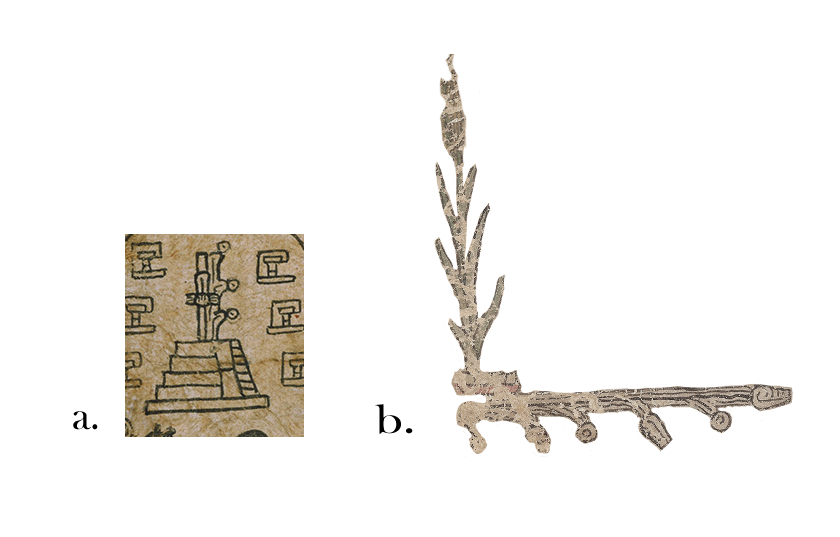
But what about the actual reading of the ‘water-reed’ glyph? If we were to follow Whittaker’s suggestion regarding the non-initial motivation of certain phonetic readings in Aztec writing, then the logogram PIAZ, piaz(tli), ‘long squash, drinking straw’, represented as a reed in both Aztec and Mixtec iconography, would be subject to non-initial phonetic derivation here, and yield the reading value az, thus obtaining the full reading az, Az(tlan), ‘Aztlan’. This proposal would make sense in all the contexts on which this sign appears, given that it seems to work both as a place name in folio 1, and as an ethnonym in folios 3 and 4. For example, another clue to understand this sign as both a place name and an ethnonym comes from the textual parallel of folio 4 of Codex Boturini with the alphabetic account found in Codex Aubin; the text of the latter states that, after the sacrifice of the mimixcoa, the Aztec stopped using this ethnonym and started calling themselves Mexica. Thus, the PIAZ/az glyph dissapears from the pictorial account of the Boturini just at the same point as the name Aztec does from the alphabetic accounts of the Mexica pilgrimage. The reading could also fit with the variant that appears at the Codex Mexicanus (Figure 4), if we conceive the tla glyph as infixed in this compound; the ‘drinking straw’ sign would be iconographically represented by the depiction of a complete reed plant atop water, an iconographic ambiguity present in other instances of the ACA, aca(tl) ‘reed’ sign, which varies between a depiction of a dried, cut cane adorned with feathers, and the plant itself, still green (cfr. Lacadena and Kettunen 2014: 31), and which could be extended to the PIAZ/az sign.

Figure 4. The Aztlan toponym: az, Az(tlan) a) Codex Boturini f. 1; b) Codex Mexicanus, where the tla would be infixed, and the cane glyph would be even more naturalistic, giving the reading a-az-tla, Aztla(n).

As it is well known, Aztlan doesn’t have an agreed etymology, presenting up to five different proposals in the sources alone (cfr. Navarrete Linares 2011: 104-106). A colleague, Gabriel Kruell, recently suggested to me that this would be because Aztlan could be a Nahuatl rendering of a non-Nahuatl word; for example, Ixtlilxochitl mentions that Nahuatl was not the original language of the Aztlaneca or inhabitants of Aztlan (1891: 106). If this is the case, perhaps this could explain that the written form of this name would be hesitant to use a better-known glyph, like the glyph AZTA, azta(tl), ‘heron’, to convey the az syllabic sequence.

Of course, the main problem with this proposal is the need to further our understanding of these apparent non-initially motivated signs in Aztec writing, as well as other similarly anomalous signs. Unlike regular syllabograms, these examples seem to be mostly hapax in nature, and in the case of pil seem to admit a rather uncommon CVC structure. Furthermore, unlike yo, examples like az or pil don’t seem to be that relevant for the currently accepted syllabic grid, which is composed by signs that appear as syllabograms in a systemic, predictable fashion (cfr. Kettunen and Lacadena 2014); perhaps, then, if they become accepted, these anomalous readings could be integrated into the entry for their respective ‘parent’ logograms rather than into the ‘main’ syllabic grid. In any case, given the lack of agreement on how to analyse these glyphs or whether to accept these exceptional cases of non-initial derivation, I propose this reading as a tentative suggestion rather than as a fact, but I find it to be the most satisfying interpretation for me at the moment, since it doesn’t incorporate any new elements to the known historical narrative, and instead just ammends a bit our understanding of how this particular sign was read in this context.

Acknowledgements

I want to thank Dr Gabriel Kenrick Kruell for his comments on this idea, and for his encouragement on disseminating it. All opinions stated here are mine alone.

Addendum

Having finally read Whittaker’s recent (and important) book on Aztec writing (2021), it is perhaps surprising that this fascinating glyph is merely mentioned in passing there, but the implicit analysis is the same (not surprising, of course, given that my analysis was inspired by Whittaker’s work in the first place): “A histerophonic value (is) a phonetic value derived, not acrophonically from the initial section of a word base or logogram, but hysterophonically from its final section. Examples of this of Aztec date are pil from HUIPIL(LI), “blouse”, az from PIAZ(TLI), “water pipe”, and hua3 from IZHUA(TL), “leaf” (Whittaker 2021: 190). I believe that the fact that in three different occasions, which is Johansson (2016), this note from 2021, and Whittaker’s book, published a month after (2021), the same explanation has been given to this sign, makes the case for it being the correct interpretation rather strong. Finally, I must say that, personally, I do not claim any precedence on this analysis, since the first to identify correctly the iconography of the glyph was, to my notice, Patrick Johansson, and Gordon Whittaker’s explanation of the mechanism behind it takes precedence over this note; however, given the importance of this glyph for the history of the people who are still known as Aztecs in the majority of languages of the world, I felt it was necessary to develop the argument in extenso.

References

Barlow, Robert H. 1949. “El Códice Azcatitlan”. Journal de la Société des Americanistes 38: 101-135. Facsimile edition, Paris.

Castañeda De La Paz, María. 2010. “El Códice X o los anales del grupo de la Tira de la Peregrinación. Evolución pictográfica y problemas en su análisis interpretativo”, Journal de la Société des américanistes 91(1): 7-40.

Castañeda de la Paz, María. 2007. “«La Tira de la peregrinación y la ascendencia chichimeca de los tenochca.” Estudios de Cultura Náhuatl 38: 183-212.

Ixtlilxochitl, Fernando de Alva. 1891. “Las naciones que hubo en la Nueva España y hasta hoy en día, y las lenguas que usa cada nación” In Obras Históricas, Tomo 1: Relaciones, ed. Alfredo Chavero, 106-109. Mexico: Oficina Tipográfica de la Secretaría de Fomento.

Johansson, Patrick. 2016. “La imagen de Aztlan en el “Códice Boturini.” Estudios de Cultura Náhuatl 51: 111-172.

Lacadena, Alfonso, and Harri Kettunen, 2014. Sistemas de escritura mesoamericanos: Escritura náhuatl. Manual for the Workshop organised at the University of Helsinki, March 17-April 2.

Navarrete, Federico. 2011. Los orígenes de los pueblos indígenas del valle de México: Los altépetl y sus historias. México: Universidad Nacional Autónoma de México / Instituto de Investigaciones Históricas.

Seler, Eduard. 1960. Gesammelte Abhandlungen zur Amerikanischen Sprach- und Altertumskund, vol 2. Graz: Akademisehe Druek- u. Verlag-sanstalt.

Rajagopalan, Angela Herren. 2019. Portraying the Aztec Past: The Codices Boturini, Azcatitlan, and Aubin. Austin, TX: University of Texas Press.

Tena, Rafael. Códice Aubin. Edición facsimilar, vol. 2. México: Secretaría de Cultura / Instituto Nacional de Antropología e Historia.

Tezozomoc, Hernando de Alvarado. 2003. Crónica Méxicana. Madrid: Promolibro.

Whittaker, Gordon. 2009. “The Principles of Nahuatl Writing.” Göttinger Beiträge zur Sprachwissenschaft 16: 47‐81.

Whittaker, Gordon. 2021. “The Controversial Relationship between Aztec Iconography and Writing.” Presentation at the INSCRIBE Workshop, Production of Images and Language Notation, Zoom, 12-15 January.

Whittaker, Gordon. 2021. Deciphering Aztec Hieroglyphs: A guide to Nahuatl writing, Berkeley: University of California Press.